|
Allgemeines zum Wahlablauf Rock-Ola 1448
und 1454 |
|
General information about Rock-Ola 1448 and
1454 selection procedure |
|
Die Tastatur hat 3
Kontaktreihen mit jeweils einem Umschaltkontakt. Dabei sind alle
Ruhekontakte (NC) jeweils in Serie geschaltet.
Die Selectorspulen sind in 6 Gruppen aufgeteilt (1-20, 21-40, usw). Die
"heißen" Enden von jeweils 6 Spulen sind verbunden (z. B. 1, 21, 41, 61,
81 und 101). Das "kalte" Ende wird erst beim Wählen mittels der
Gruppenrelais (auch Clappercoils genannt) auf Masse gelegt.
Wenn eine Taste gedrückt wird, wird über die hintere Kontaktreihe ein
Stromkreis vorbereitet zu den entsprechenden "heißen" Enden der
Selectorspulen (z. B. 1, 21, 41, 61, 81 und 101). Welche der
Selectorspulen dann aktiviert wird, ist davon abhängig, welches
Gruppenrelais aktiviert wird.
Über die mittlere Kontaktreihe und über die Kontakte der Programmtrommel
wird ein Stromkreis vorbereitet zu einem der Gruppenrelais
(Clappercoils). Das ist eine vereinfachte Darstellung, denn es gibt 40
Tasten, jede Gruppe hat aber nur 20 Selectorspulen. Die tatsächliche
Schaltung ist daher etwas komplizierter.
Diese Vorgänge passieren immer wenn eine Taste gedrückt wird.
Ob
tatsächlich eine Wahl durchgeführt wird, hängt davon ab, ob Kredit
vorhanden ist, d. h. ob der entsprechende Kontakt auf der
Akkumulatoreinheit geschlossen ist.
Wenn der Kontakt geschlossen ist, wird bereits im Ruhezustand (keine
Taste gedrückt!) der 300 µF-Elko in der Krediteinheit aufgeladen.
Der Elko hat zwei Sektionen. Auf der einen Sektion müssen immer etwa +
30V liegen. An der zweiten Sektion muß die gleiche Spannung anliegen,
sobald Credit vorhanden ist. Der Strom geht dabei von der ersten Sektion
des Elkos über einen Kontakt auf dem Kredit-Akkumulator und über eine
Reihenschaltung aller 40 Tasten zur zweiten Sektion.
Beim Drücken einer Taste entlädt sich dieser
Elko über die Rückstellspule der Akkumulatoreinheit. Diese zieht dadurch
kurzzeitig an, stellt die Akkumulatoreinheit um einen Schritt zurück und
betätigt zwei Kontakte, die eine Spannung an die zwei vorbereiteten
Stromkreise legen. Es wird also eine der Clappercoils und dadurch auch
eine der Selectorspulen aktiviert. Es gibt noch einen weiteren Kontakt
auf der Programmtrommel. Dieser verhindert, daß eine Wahl durchgeführt
wird, während die Programmtrommel sich dreht.
Das Playrelais im Netzteil wird aktiviert, wenn ein Wahlpin nach außen
gestellt wird und zwar unabhängig, davon, ob durch eine Wahl mit der
Tastatur oder händisch. Dafür ist die Scanleitung zuständig. |
|
The keyboard has 3 rows of
contacts, each with a changeover contact. All "normally closed" (NC)
contacts are connected in series.
The selector coils are divided into 6 groups (1-20, 21-40, etc.). The
“hot” ends of each of the 6 coils are connected (e.g. 1, 21, 41, 61, 81
and 101). The “cold” end is not connected to earth until the group
relays (also known as clapper coils) are used for selection.
When a button is pressed, a circuit is prepared via the rear row of
contacts to the corresponding “hot” ends of the selector coils (e.g. 1,
21, 41, 61, 81 and 101). Which of the selector coils is then activated
depends on which group relay is activated.
A circuit is prepared to one of the group relays (clapper coils) via the
middle row of contacts and via the contacts of the title drum. This is a
simplified representation, as there are 40 buttons, but each group only
has 20 selector coils. The actual circuit is therefore somewhat more
complicated.
These sequences always take place when a button is pressed.
Whether a selection is actually made depends on whether credit is
estalished, i.e. whether the corresponding contact on the accumulator
unit is closed.
If the contact is closed, the 300 µF electrolytic capacitor in the
credit unit is already charged in the idle state (no button pressed!).
The electrolytic capacitor has two sections. There must always be about
+ 30V on one section. The same voltage must be applied to the second
section as soon as credit is estabished. The current goes from the first
section of the electrolytic capacitor via a contact on the credit
accumulator and via a series connection of all 40 pushbuttons to the
second section.
When a button is pressed, this electrolytic capacitor discharges via the
reset coil of the accumulator unit. This briefly picks up, resets the
accumulator unit by one step and actuates two contacts that apply a
voltage to the two prepared circuits. This activates one of the clapper
coils and thus also one of the selector coils. There is another contact
on the program drum. This prevents a selection from being made while the
title drum is rotating.
The play relay in the power supply unit is activated when a selector pin
is set to the outside, regardless of whether it is selected using the
keyboard or manually. The scan line is responsible for this. |
|
|
|
Rock-Ola 1454: reagiert nicht auf die Tasten 101-120. Die Spulen in
der Wahltrommel ziehen nicht an. Werden die Wahlstifte von Hand gezogen,
wird die Wahl gefunden. Kann es sein, dass die 'Switcher' in der Trommel
damit zu tun haben? |
|
Rock-Ola 1454: does not
respond to buttons 101-120. The coils in the selector do not attract. If
the selection pins are pushed by hand, the selection is found. Is it
possible that the 'switchers' in the drum have something to do with this? |
Wenn wirklich nur 101 bis 120 nicht gehen (und nicht auch 21-40 und 61-80
- dann läge es eher an der Tastatur), dann ist es wohl die
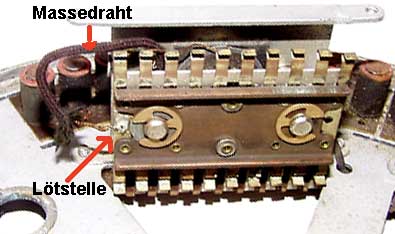
"Clapper Coil" im Selector. Gerne reißen dort die Masseverbindungen zum
Schaltstück ab.
Wenn man von hinten in die Musikbox hineinsieht und vorne drückt jemand eine
Wahl zwischen 101 und 120, dann sollte man beobachten können
(Taschenlampe?), ob sich das Schaltstück im Selector überhaupt bewegt
(kann man aber eigentlich auch hören).
Das zu prüfende Schaltstück ist (von hinten auf den Selector geblickt)
auf etwa 8:00 Uhr (Selectorkreis als Uhrzifferblatt gedacht).
Bewegt sich das Schaltstück gar nicht, solltest Du mal die
Steckerkontakte zwischen Selector und Tastatur prüfen, bzw. den
Durchgang an Pin 26 eben jener Steckerverbindung durchpiepsen.
Vielleicht ist ja der Draht 26 im Stecker ab. Die Nummerierung der
Steckerpins ist allerdings nur innen im Stecker zu sehen. Man muss ihn
also öffnen oder man weiß auch von außen wo die Nr. 1 lieg .....
Da der Stecker aber nur 27 Pins hat, liegt die 26 in der Mitte der drei
Kontakte am einen oder anderen Ende der Dreier-Kontaktreihen.
Pin 26 deshalb: 20 Drähte für 20 Selectorspulen, die mit 6 Clappercoils
auf 120 Wahlen elektrisch "multiplizert" werden.
Sollte der Massedraht ab sein bleibt nichts übrig als den Selector
auszubauen, ihn zu öffnen und den Draht wieder anzulöten. Manchmal
funktioniert es aber auch mit abgerissenem Draht, weil das Schaltstück ja
auf zwei Bolzen gelagert ist, welche Massepotential haben. (Axel
Rosenberger) |
|
If only 101 to 120 really don't
work (and also not 21-40 and 61-80 - then it's more likely
caused by the keyboard), then it's probably the “clapper coil”
in the selector. The ground connections to the switch often
break off there.
If you look into the jukebox from behind and someone presses a
selector between 101 and 120 at the front, you should be able to
observe (flashlight?) whether the switch in the selector moves
at all (but you can actually also hear it).
The switching piece to be tested (looking at the selector from
rear) is at about 8:00 o'clock (selector circuit intended as a
clock face).
If the switch does not move at all, you should check the plug
contacts between the selector and the keyboard, or check the
continuity at pin 26 of the same plug connection. Perhaps wire
26 in the plug is broken. However, the numbering of the
connector pins can only be seen on the inside of the connector.
So you have to open it or you can also see from the outside
where number 1 is .....
However, as the plug only has 27 pins, the 26 is in the middle
of the three contacts at one end or the other of the three
contact rows.
Pin 26 therefore: 20 wires for 20 selector coils, which are
electrically “multiplied” by 6 clapper coils to 120 selections.
If the ground wire is off, there is nothing to do but remove the
selector, open it and solder the wire back on. Sometimes it also
works with the wire torn off, because the selector is mounted on
two bolts which have ground potential. (Axel Rosenberger) |
|
|
|
|
Rock-Ola 1448: durch Nikotin u. dgl.
ziemlich verdreckt. Für eine Wahl müssen die Hebel des Selector des
Öfteren hin und her bewegt werden, damit die Wahl genommen wird. Kredit
geben funktioniert, wird nach auch entsprechend abgezogen. Was sollte
ich als erstes machen? |
|
Rock-Ola 1448: Quite dirty
due to nicotine and the like. For a selection, the levers of the
selector must be moved back and forth several times so that the
selection is taken. Giving credit works, it is also deducted accordingly.
What should I do first? |
|
1. den Doppelelko im Kreditwerk tauschen.
Dieser hat nach 50 Jahren sehr wahrscheinlich nicht mehr die notwendigen Kapazitäten.
2. den Selector ausbauen, zerlegen, reinigen und wieder zusammenbauen.
Eine Anleitung dazu gibt es
hier. |
|
1. Replace the double
electrolytic capacitor in the credit unit. After 50 years, most likely
this doesn't have the necessary capacity any longer.
2. Remove the selector, disassemble, clean and reassemble. Instructions
can be found
here
(German only). |
|
|
Rock-Ola 1454: statt 21 – 40 werden die
Wahlen 101 - 120 gespielt. Werden 101 – 120 direkt angewählt, werden sie korrekt
abgesielt. Auch alle anderen Wahlen funktionieren einwandfrei. |
|
Rock-Ola 1454: Instead of 21
- 40 selections 101 - 120 are played. If 101 - 120 are selected directly,
they are played correctly. All other selections also work fine. |
Das liegt vermutlich an
der Titelwalze. Einer der Mikroschalter schaltet vermutlich nicht
richtig (Justierung), oder ist defekt!
Häufig sind diese Mikroschalter durch Nikotin oder Schmutz verklebt!
Die Schalter sitzen links an der Walze.
Zum Messen der Mikroschalter sollte in Ohmmeter verwendet werden. Nur
messen, ob der Schalter einwandfrei schaltet, wenn die Schaltnocke
einrastet. |
|
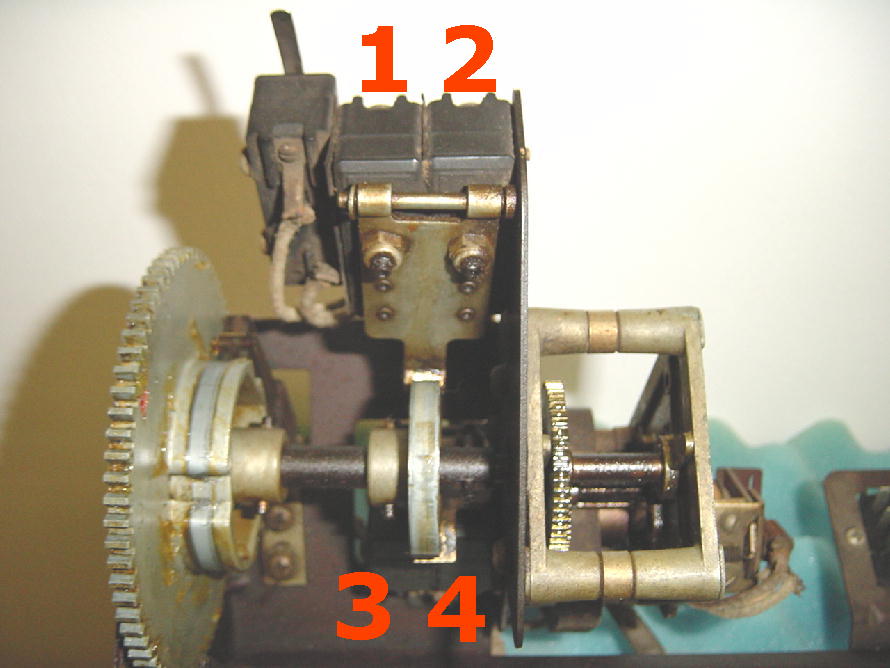
This is probably due to the title
drum. One of the microswitches is probably not switching
correctly (adjustment) or is defective! These microswitches are
often gummed up by nicotine or dirt! The switches are located on
the left-hand side of the title drum.
An ohmmeter should be used to measure the microswitches. Only
measure whether the switch operates correctly when the switch
cam engages. |
 |
| |
|
Funktion der Titelwalze Rock-Ola 1448 |
|
Function of title drum in Rock-Ola 1448 |
Die
Rock-Ola 1448 hat 3 Walzenstellungen (3 x 40 Wahlen = 120
Wahlen). Zwei Mikroschalter sind für die drei Stellungen der
Walze verantwortlich:
Microschalter Nr. 1 betätigt, Microschalter 2 nicht betätigt =
Walzenstellung 1 = Wahlen 1 - 40
Microschalter Nr. 2 betätigt, Microschalter 1 nicht betätigt =
Walzenstellung 2 = Wahlen 41 - 80
Kein Microschalter betätigt oder aber beide = Walzenstellung 3
= Wahlen 81 - 120 |
|
There are 4 micro
switches on the left side of the title drum for the selections
and one for the title drum (left, next to #1)
The micro switches are located near the motor for the program
drum. There are two switches for the selection system and one
which inhibits the rotation of the drum, as long as the lower
front door is not closed completely.
If microswitch #1 is pressed, selections 1 - 40 can be made.
If microswitch #2 is pressed, selections 41 - 80 can be made.
If both or none switch is pressed, selections 81 - 120 can be
made. |
Photo by courtesy of B&K -
made before restoration |
|
|
|
Schalter
Programmwalze Rock-Ola 1454 |
|
Switch at
titledrum Rock-Ola 1454 |
|
Die Rock-Ola Modelle 1454 mit drehbarer Programmwalze haben
einen Schalter der verhindert, dass bei ausgekippter Tastatur die Walze
(ungewollt) weitergedreht wird, z.B. beim Tauschen der Titelstreifen
Dieser Schalter ist erst ab der 1454 eingebaut worden, ist also nicht in
der 1448 vorhanden. |
|
Rock-Ola models 1454 with titledrum have a switch which prevents to turn the titledrum when the keyboard
has been swung out. This helps to not turn the titledrum (by
accident) e.g. when changing titlestrips.
This switch was used in 1454 models first, means it is not mounted
in model 1448 already. |
|
|
Normalerweise hält die
Titelwalze der R.O. 1455 automatisch bei jeder Seite an.
Jetzt läuft sie aber, solange man den Programmknopf drückt, immer
weiter. Woran kann das liegen? |
|
Usually the title drum of
Rock-Ola 1455 stops at each side . But now it rturn continously when
pressing the programm knob. What might cause this? |
|
Die 1455 hat eine
fünfeckige Walze mit 5 x 40 Wahlen.
Die 5 Stellungen der Walze werden durch offene Schaltereinheiten
abgefragt. Es sind keine Mikroschalter, die offenen Schalterblöcke
sollten gereinigt sein.
Es gibt e i n e n Schalterblock für jede Walzenstellung und einen
zusätzlichen Kontakt, der die Endstellung (= Stehenbleiben der Walze)
erkennt und den Motor abschaltet. An dem zuletzt genannten Schalter
könnte der Fehler zu finden sein (Sauberkeit ! Justierung !).
Zusätzlich sollte auf den richtigen Einbau der Zahnräder geachtet
werden. Diese haben entsprechende Markierungen, die beim Einbau in
gleicher Linie stehen müssen.
|
|
The 1455 has a pentagonal title drum with 5 x 40
selections.
The 5 positions of the title drum are queried by open switch units.
There are no microswitches, the open switch blocks should be cleaned.
There is a switch block for each title drum position and an additional
contact which recognizes the end position (= title drum stops) and
switches off the motor. The fault could be found in the latter switch (cleanliness
! adjustment !).
Attention should also be paid to the correct installation of the gear
wheels. These have corresponding markings which must be in the same line
during installation. |
|
|
Rock-Ola 1458: mit der Wahl Nr. 19 (A-Seite)
wird auch die B-Seite (20)
abgespielt. Wählt man dagegen die Nr. 20, erfolgt keine Wahl, der Pin
wird nicht gesetzt. Das ist in allen Walzenstellungen. |
|
Rock-Ola 1458: If no. 19
gets selected (A-side), the B-side (20) also gets played. However, if
no. 20 gets selected, no selection is made and the pin is not set. This
is the case in all title drum positions. |
|
Das Problem sollte in der Tastatur zu finden sein.
Vermutlich ist das Kabel zur Taste Nr. 20 ab und kommt an die
Verbindung zu Taste Nr. 19.
|
|
The problem should be located in the keyboard.
Probably the wire to pushbutton no. 20 is off and touches the connection
to pushbutton no. 19. |
|
Die Angaben haben keinen
Anspruch auf Vollständigkeit oder Richtigkeit.
Bei den (importierten) Boxen können im Laufe der Jahre durchaus
Veränderungen vorgenommen worden sein. Copyright.
<<<
zurück
zur Archiv-Übersicht
|
Ein Service von

Copyright by
Stamann Musikboxen |