|
Wahl: Ablauf bei Rock-Ola Musikboxen mit seitlichem Magazin
- Modelle 1484, 1493, 1494, 404, 414 ... bis 446 |
|
Selection: General description for models with sidewards magazin
- models 1484, 1493, 1494, 404, 414 ... to 446 |
|
Im Standby Betrieb ist der Schalthebel von
Mikroschalter #1 in der Vertiefung, d. h. der Schalter ist nicht
betätigt. Das Interlock Relais ist in Release-Stellung (das Release
Relais ist in gedrückter Stellung verriegelt). Der Stromkreis für den
Magazinmotor ist dadurch vorbereitet.
Mikroschalter #2 ist gedrückt und schließt den 15 Ohm Widerstand kurz.
Mikroschalter #3 ist ebenfalls gedrückt und schaltet das Mute Relais im
Verstärker ein.
Nach einer Wahl wird die Betriebsspannung durch das
Play Control Relais eingeschaltet und das Magazin beginnt zu laufen.
Wenn eine Wahl gefunden wird, zieht das Interlock Trip Relais an. Ein
Kontakt darauf ist ein Selbsthaltekontakt, der ein sicheres
Durchschalten gewährleisten soll. Die Selbsthaltung bleibt bestehen, bis
der Strom für den Magazinmotor tatsächlich abgeschaltet ist. Der zweite
Kontakt bereitet den Stromkreis für die Löschspulen vor. Durch das
Anziehen des trip Relais wird das Release Relais freigegeben und die
Kontakte darauf schalten ebenfalls um. Dadurch wird der Magazinmotor
abgeschaltet, die dynamische Bremsung wird eingeleitet und gleichzeitig
wird der Greifermotor eingeschaltet.
Wenn der Greifermotor losläuft, wird als erstes der Mikroschalter #1
umgeschaltet. Der Strom und auch die dynamische Bremsung für den
Magazinmotor wird dadurch abgeschaltet. Stattdessen wird ein Stromkreis
für das Reverse Relais vorbereitet. Kurz bevor das Auflegen der Platte
beendet ist, schaltet auch Mikroschalter #2 um. Dadurch wird der Kurzschluß über dem Widerstand aufgehoben und der Greifermotor läuft
langsamer, bis die Platte aufgelegt ist. Gleichzeitig wird der Strom für
die Löschspulen (Selection Lever Reset Coils) eingeschaltet. Welche der
Löschspulen anzieht, hängt von der Stellung des A-B Snap Switch ab.
Wenn die Platte vollständig aufgelegt ist, schaltet Mikroschalter #3
um. Dadurch wird das Mute Relais abgeschaltet und stattdessen das Interlock
Release Coil eingeschaltet. Die Kontakte darauf schalten den
Greifermotor ab und die dynamisch Bremsung des Motors ein. Das Release Coil bleibt angezogen bis die Platte zu Ende spielt oder
der Cancel - Taster betätigt wird.
Wenn der Tonarmendschalter oder der Cancel - Taster betätigt werden,
zieht das Reverse Relais und auch das Mute Relais an. Ein Kontakt auf
dem Reverse Relais schaltet den Greifermotor mit umgekehrter Polarität
ein und dieser beginnt, die Platte zurück zu legen. Als erstes schaltet
nun Mikroschalter #3 um und stellt sicher, dass das Reverse Relais
angezogen bleibt, bis die Platte vollständig zurück gelegt ist und
Mikroschalter #1 umschaltet. Wenn dieser umschaltet, fällt das Reverse
Relais ab, der Greifermotor wird abgeschaltet und dynamisch gebremst,
der Magazinmotor wird eingeschaltet. |
|
In standby mode, the switching
lever of microswitch #1 is in the recess, i.e. the switch is not
actuated. The interlock relay is in the release position (in the pressed
position the release relay is locked). The circuit for the magazine
motor is thus prepared.
Micro switch #2 is pressed and short-circuits the 15 Ohm resistor.
Micro switch #3 is also pressed and hence activates the mute relay in
the amplifier.
After a selection, the
operating voltage is switched on by the play control relay and the
magazine starts to run.
When a selection is found, the
interlock trip relay is energised. One contact on it is a latching
contact designed to ensure safe switching. The latching action remains
in place until the current for the magazine motor is actually switched
off. The second contact prepares the circuit for the cancel coils. When
the trip relay is energised, the release relay is released and the
contacts on it also switch over. This switches off the magazine motor,
dynamic braking is initiated and the gripper motor is switched on at the
same time.
When the gripper motor starts
running, microswitch #1 is switched first. This switches off the current
and also the dynamic braking for the magazine motor. Instead, a circuit
is prepared for the reverse relay. Shortly before placing the record on
the turntable is completed, microswitch #2 also switches over. This
cancels the short circuit across the resistor and the gripper motor runs
more slowly until the record has been placed. At the same time, the
current for the cancel coils (selection lever reset coils) is switched
on. Which of the cancel coils is energised depends on the position of
the A-B snap switch.
When the record is fully loaded,
microswitch #3 switches over. This switches off the mute relay and switches on the interlock release coil instead. The contacts on it
switch off the gripper motor and switch on the dynamic braking of the
motor instead. The release coil remains energised until the record has
finished playing or the cancel button is pressed.
When the tonearm cut-off switch
or the cancel button is pressed, the reverse relay and the mute relay
are energised. A contact on the reverse relay switches on the gripper
motor with reversed polarity and it starts to put the record back.
First, microswitch #3 switches over and ensures that the reverse relay
remains energised until the record is fully returned and microswitch #1
switches over. When this switches, the reverse relay releases, the
gripper motor is switched off and dynamically braked, the magazine motor
is switched on. |
|
|
|
Wahl: Allgemeine Beschreibung für Modelle mit seitlichem Magazin
- Modelle 1484, 1493, 1494, 404, 414 ... bis 446 |
|
Selection: General description for models with sidewards magazin
- models 1484, 1493, 1494, 404, 414 ... to 446 |
|
Wenn die zwei Tasten gedrückt werden, wird ein
Stromkreis zu den Schleifkontakten auf der Wählscheibe hergestellt.
Außerdem zieht das Einschreibrelais an und dieses schaltet den
Einschreibmotor ein. Sobald die Schleifer auf den vorbereiteten
Stromkreis kommen, wird der Stromkreis für das Stopprelais geschlossen.
Dieses zieht an, wodurch der Einschreibmotor stoppt. Daraufhin wird ein
Kredit abgezogen, ein Wählhebel umgelegt und so weiter.
Falls der Einschreibmotor ununterbrochen läuft:
Wahrscheinlich können die Schleifkontakte den vorbereiteten Stromkreis
nicht finden. In den meisten Fällen liegt es an einer verschmutzten oder
oxidierten Schleifkontaktplatte.
Ein weiterer Grund können die Drucktasten sein. Jeder der Tastenblöcke
hat mehrere Reihen von Schaltern. Eine Reihe dient dazu, den Stromkreis
zu den Segmenten der Wählscheibe vorzubereiten. Die Schalter sind in
Reihe geschaltet. Der Strom wird an die Taste A oder 1 geleitet.
Wenn eine Taste nicht gedrückt wird, wird der Stromkreis mit der
nächsten Taste verbunden.
Wird eine Taste gedrückt, wird die Reihenschaltung an dieser Stelle
unterbrochen und auf das entsprechende Segment der Wählscheibe
umgeschaltet.
Es kommt häufig vor, dass die Reihenschaltung an einer oder mehreren
Stellen unterbrochen wird, obwohl die Taste nicht gedrückt wird. Dies
hat zur Folge, dass alle nachfolgenden Tasten keine Funktion haben. |
|
When two selection keys are pressed, a circuit to the
sliding contacts on the selector disc is prepared. In addition, the
write-in relay attracts and this turns on the write-in motor.
As soon as
the wipers come on the prepared circuit, the circuit will be closed for
the stop relay. This one attracts, causing the write-in motor to stop.
Subsequently, a credit is subtracted and a selector lever is switched, and
so on.
In case the write-in motor runs
continuously:
Most likely the sliding contacts can not find the prepared circuit. In
most cases it is caused by a dirty or oxidized sliding contact plate.
Another reason might be the pushbuttons. Each of the switch blocks has
several rows of switches. One row is used to prepare the circuit to the
segments of the selector disc. The switches are connected in series. The
current is supplied to the button A, or 1.
When a button is not pressed, the circuit is connected to the next
button.
When a button is pressed, the series connection is interrupted at this
point and switched to the corresponding segment on the selector disc.
It often happens that the series connection is interrupted at one or
more points, even though the button is not pressed. The result is that
all subsequent buttons have no function.
|
|
|
|
Wahl: Ablauf in Modelle mit seitlichem Magazin bis Rock-Ola 474 - Videosequenz auf YouTube |
|
Selection: Process in models with sidewards magazin
up to 474
video sequence on YouTube |
|
Vielen Dank an
marcrhsn
und Charly49:
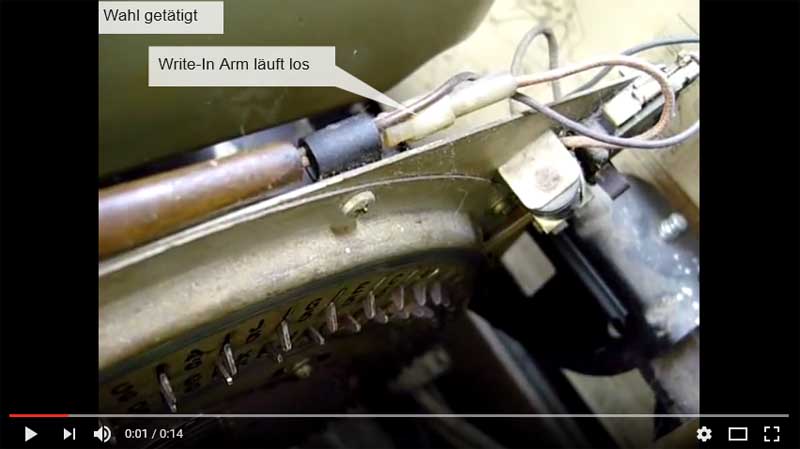
In groben Zügen
funktioniert die Wahl bei allen Rock-Ola Modellen (Modelle 1484, 1493,
1494, 404,
414 bis 476) so:
Wenn eine Wahl gemacht wird, wird von der Tastatur ein Stromkreis
vorbereitet zu den Schleifkontakten auf der linken Seite der
Selectorscheibe. Der Arm auf der linken Seite (Write In Arm) beginnt,
sich zu drehen. Wenn die Schleifkontakte auf den vorbereiteten
Stromkreis treffen, wird der Motor gestoppt und Rückstellspule in der
Crediteinheit (Reset Coil) wird aktiviert. Dadurch wird ein Kredit
abgezogen. Die Kontakte auf der Reset Coil aktivieren eine der Spulen (Write
In Coil) auf dem Write In Arm, wodurch der entsprechende Wahlhebel (Selection
Lever) umgelegt wird. Gleichzeitig wird auch die Spule am oberen Rand
der Selectorscheibe (Wobble Plate Coil) aktiviert, wodurch das Umlegen
des Wahlhebels erleichtert wird. Es wird ferner noch ein Relais (Attract
Delay Relay) aktiviert, das den Wahlvorgang beendet und bewirkt, daß die
Tasten ausgelöst werden.
Video auf YouTube: Zum Öffnen auf das Bild klicken
|
|
In rough terms, this is how
selection works on all Rock-Ola models (models 1484, 1493, 1494,
404, 414 to 476):
When a selection is made, a circuit is prepared from the keyboard to
the sliding contacts on the left side of the selector disc. The arm
on the left-hand side (write-in arm) starts to rotate. When the
sliding contacts hit the prepared circuit, the motor gets stopped
and the reset coil in the credit unit is activated. This draws off a
credit.
The contacts on the reset coil activate one of the coils (write-in
coil) on the write-in arm, causing the corresponding selection lever
to be moved. At the same time, the coil on the upper edge of the
selector disc (wobble plate coil) is also activated, which makes it
easier to move the selection lever. A relay (Attract Delay Relay) is
also activated, which ends the selection process and causes the
buttons to be triggered.
Video at YouTube: Click to play
|
|
|
|
|
Allgemeiner Wahlablauf Rock-Ola Modelle mit
digitaler Wahl über drei Ziffern – Modelle ab 448, 449 bis 474 |
|
General selection sequence
Rock-Ola models with digital selection using three digits -
from model 448, 449 up to 474 |
|
Voraussetzung ist, dass Kredit vorhanden ist. Es muss mníndestens die
"Single Selection"-Lampe leuchten. Dann:
1. Ziffer eingeben: "1. ZIFFER" bzw. "!st DIGIT" muss leuchten.
Als erste Ziffer ist nur 1 oder 2 möglich.
2. Ziffer eingeben: "2. ZIFFER" bzw. "2nd DIGIT" muss ebenfalls leuchten
und der Tastenverriegelungs-Magnet muss anziehen.
3. Ziffer eingeben: Die Taste wird verriegelt. Der Write-In Arm (auf
der linken Seite der Selectorscheibe) läuft an. Sobald er die Position
der gewählten Platte erreicht, stoppt er und legt den entsprechenden
Wahlhebel um. Gleichzeitig wird die Taste freigegeben und
die Anzeigelampen "1. Ziffer" und "2. Ziffer" erlöschen. Dann läuft das
Magazin an um die gewählte Platte zu spielen.
Wenn eine Ziffer außerhalb des erlaubten Bereichs gedrückt wird,
leuchtet "RESET DRÜCKEN UND NEU WÄHLEN" bzw. bei englischer Beschriftung
"RESET AND RESELECT" auf und alle weiteren Eingaben sind gesperrt, bis
die RESET - Taste gedrückt wird.
Die ersten beiden Ziffern müssen zwischengespeichert werden.
Für die erste Ziffer gibt es ein Relais, das angezogen (für Ziffer #1)
oder nicht angezogen (für Ziffer #2) wird. Damit wird festgelegt, ob die
innere oder äußere Einschreibspule aktiviert werden kann, sobald die
Wahlposition erreicht wird. Für die zweite Ziffer gibt es eine Reihe von
10 Thyristoren, von denen einer getriggert wird und bis zum Abschluss der
Wahl eingeschaltet bleiben muss. Dieser Thyristor legt die entsprechenden
Kontakte an Masse. Beim dritten Tastendruck rastet die Taste ein und
verbindet den unteren Anschluss des Stopp Relais mit einem der Segmente auf
der Selector-Schleifplatte. Sobald der Schleifkontakt dieses Segment
mit der auf Massepotential liegenden Kontaktniete verbindet, zieht das Stopprelais an und die Wahl wird eingeschrieben.
Der ganze Vorgang ist im Servicemanual sehr schön beschrieben. |
|
Required is is that credit is
available. At least the ‘Single Selection’ lamp must be lit. Then:
Enter the 1st digit: ‘1. DIGIT’ or ‘!st DIGIT’ must light up. Only 1 or
2 is possible as the first digit.
Enter the 2nd digit: ‘2nd NUMBER’ or ‘2nd DIGIT’ must also light up and
the latch bar solenoid must attract.
Enter the 3rd digit: The pushbutton is locked and the write-in arm (on
the left side of the selector disc) starts running. As soon as it
reaches the position of the selected record, it stops and moves the
corresponding selector lever. At the same time, the button is released
and the ‘1st digit’ and ‘2nd digit’ indicator lights go out. The record
magazine then starts to play the selected record.
If a digit outside the permitted range is pressed, then "RESET DRÜCKEN
UND NEU WÄHLEN" or, in the case of English instruction labels, "RESET
AND RESELECT" will light up and all further entries are blocked until
the RESET button is pressed.
The first two digits must be buffered, so to speak. For the first digit,
there is a relay that is energised (for digit #1) or not energised (for
digit #2). This determines whether the inner or outer write-in coil can
be activated as soon as the selection position is reached. For the
second digit, there is a series of 10 thyristors, one of which is
triggered and must remain energised until the selection is complete.
This thyristor connects the corresponding contacts to earth. On the
third press of the button, the button engages and connects the lower
terminal of the stop relay to one of the segments on the selector
sliding plate. As soon as the sliding contact connects this segment with
the contact rivet at earth potential, the stop relay is energised and
the selection is entered.
The whole process is described very well in detail in the service manual. |
|
|
|
Der Wahlvorgang beginnt, die
Strombegrenzungslampe leuchtet dauerhaft bis der Sicherungsautomat
reagiert. Die Wahl wird nicht eingeschrieben, also kein Wahlhebel
umgelegt.
Rock-Ola ab Modell 448, 449 bis 474 |
|
The selection sequence starts,
the current limit lamp is on continuously until the circuit breaker
reacts. The selections doesn't get written in, means no selection pin
gets set.
Rock-Ola from model 448, 449 up to 474 |
|
Bis zu dem Moment, an dem der Einschreibarm die gewählte Position
erreicht, scheint alles richtig zu funktionieren. Das Stop Relay zieht
an und bremst den Motor dynamisch über Kontakt K4-2 und die
Strombegrenzungslampe ab. Gleichzeitig sollte über die Kontakte K4-1,
K3-4, K5-3 und eine Diode die Rückstellspule anziehen und einen Kredit
abziehen. Die Kredit Rückstellspule betätigt den Mikroschalter
K2-1. Der komplettiert den Stromkreis zur Einschreibspule und
schaltet das ADR ein. Das ADR hat über der Spule einige Kupferscheiben,
die bewirken, dass das Relais mit einer zeitlichen Verzögerung anzieht.
Wenn es dann anzieht, werden alle Stromkreise unterbrochen und das
Wahlsystem wird in den Ausgangszustand versetzt.
Ich würde auf den Mikroschalter (K-2-1) als Fehlerursache tippen.
Der gesamte Arbeitsablauf ist im Servicemanual genau beschrieben. |
|
Everything seems to be working
correctly until the moment the write-in arm reaches the selected
position. The stop relay attracts and brakes the motor dynamically via
contact K4-2 and the current limiting lamp.
At the same time, the credit reset solenoid should attract via contacts
K4-1, K3-4, K5-3 and a diode) and pull out a credit. The credit reset
solenoid actuates the microswitch K2-1. This completes the circuit to
the write-in coil and switches the ADR.
The ADR has some copper discs above the coil. These cause the relay to
energise with a time delay. When it attracts, all circuits are
interrupted and the selection system is set to the initial state.
I would suspect the microswitch K2-1 as the cause of the fault.
The entire procedure is described in detail in the service manual. |
|
|
|
Wahlproblem Rock-Ola 4xx-Serie: Wahlen
werden gar nicht oder nur teilweise gefunden. Manchmal muss mehrfach
gewählt werden.
Modelle bis 446 |
|
Selection problem Rock-Ola 4xx
series: Selection do not get or only partially found. Sometimes the
selection has to be made several times.
Models up to 446 |
|
Vermutlich werden die Wahlstifte der Selector-Unit nicht gesetzt. Hier
hilft, die Schleifbahnen zu reinigen und die Strombegrenzungslampe (GE
#309) im Kreditgerät überprüfen. Diese muss beim Setzen des Hebels kurz
aufleuchten.
Der Fehler zeigt sich unterschiedlich: mal läuft der Write-In Arm endlos
im Kreis, braucht mehrere Umläufe bis er den Hebel setzt oder er stoppt,
setzt den Hebel aber nicht.
Wenn die Lampe im Kreditgerät defekt oder lose ist stoppt der Arm zwar,
der Motor läuft aber nach. Dann wird entweder die richtige Platte, keine
Platte oder die nächste Platte gesetzt.
Eine weitere Möglichkeit
ist, dass der Fehler in der Tastatur zu suchen ist. Die Tastenkontakte
sind in Serie geschaltet. Das heißt, die Spannung wird an die Taste A
bzw. 1 zugeführt. Wenn diese nicht gedrückt ist wird die Spannung zu
Taste B bzw. 2 weitergeleitet und so weiter. Wenn z. B. die Taste A
gedrückt wird, wird die Verbindung zu Taste B unterbrochen und stattdessen wird die Spannung an das Segment A auf der Selectorscheibe
gelegt. Wenn nun ein Kontaktfehler in der Tastatur auftritt, kann es
sein, dass die Serienschaltung unterbrochen ist, obwohl keine Taste
gedrückt ist. Dadurch sind dann alle Wahlen nach der Unterbrechung
unmöglich.
Die Kontakte in der Tastatur reinigen sich selbst, wenn sie betätigt
werden. Man sollte versuchen, die Tasten A und 1 mehrmals (20 - 30 mal)
zu drücken (Musikbox ausgeschaltet). Dadurch sollten sich die Kontakte
gereinigt haben. Danach sollte die Wahl A1 funktionieren. Für die A1
sind die wenigsten Tastenkontakte in Betrieb. Wenn das funktioniert, ist
die Tastatur mit ziemlicher Sicherheit die Fehlerursache.
Hinweis: diese Beschreibung bezieht sich auf die Modelle bis zur
446, die alpha-numerisch wählen.
Ab der 447 wurde eine dreistellige Ziffer eingegeben. Das Prinzip ist
jedoch ähnlich.
|
|
The selector pins of the
selector unit are probably not set. It helps to clean the sliding tracks
and check the current limiting lamp (GE #309) in the credit unit. This
must light up briefly when the lever is set.
The error can manifest itself in different ways: Sometimes the write-in
arm runs endlessly in a circle, takes several revolutions until it sets
the lever or it stops but does not set the lever.
If the lamp in the credit unit is defective or loose, the arm stops, but
the motor continues to run. Then either the correct record, no record or
the next record is set.
Another possibility is that the
fault is in the keyboard. The pushbutton contacts are connected in
series. This means that the voltage is fed to button A or 1. If this is
not pressed, the voltage is passed on to button B or 2 and so on. If,
for example, button A is pressed, the connection to button B is
interrupted and the voltage is applied to segment A on the selector disc
instead. If a contact error occurs in the keyboard, the series
connection may be interrupted even though no button is pressed. This
means that all selections after the interruption are impossible then.
The contacts in the keyboard clean themselves when they are pressed. You
should try pressing the A and 1 buttons several times (20 - 30 times) (jukebox
switched off). This should clean the contacts. The A1 selection should
then work. For A1, the fewest pushbutton contacts are in operation. If
this works, the keyboard is almost certainly the cause of the fault.
Note: This description refers to the models up to 446, which
select alpha-numerically.
From 447 onwards, a three-digit number was entered. However, the
principle is similar. |
|
|
Wahlproblem
Rock-Ola der 4xx-Serie: Wahlen werden wiederholt
Modelle 445, 453, 461 |
|
Selection problem Rock-Ola 4xx series: Selections
get repeated
Models 445, 453, 461 et al. |
|
Bei einer R.O. 445 werden alle gewählten Titel immer wieder von
vorne an gespielt. Wenn dieses Verhalten sowohl bei den A- als auch bei
den B-Seiten auftritt, werden die Wahlen vermutlich nicht gelöscht. Das
erkennt man daran, dass die kleinen Pins am Selector nicht in die
Ursprungsstellung zurückgehen. Es ist wahrscheinlich, dass die Schleifer
bzw. Masse- oder Plus Schleifer auf der Außenseite des Vorwählaggregates
verschmutzt sind.
Abhilfe: alles gut reinigen - hier empfiehlt sich Spiritus.
Anschließend die Kupferbahnen mit ein wenig Öl (z.B. Ballistol)
einreiben. Bitte nur ein wenig davon auf einen Lappen auftragen und
einmal damit Abreiben. Das verhindert erstens Oxidation, zweitens
unnötiges Quietschen und drittens schont es auch die Leiterbahnen vor
übermäßigen Abrieb.
Hinweis: beim Reinigen der Schleifer diese nicht verbiegen oder abbrechen.
Tritt das o.g. Verhalten nur bei A- oder B-Seiten auf, könnte eine der
beiden Löschspulen defekt sein. |
|
With an R.O. 445, all selected titles are played
again and again from the beginning. If this behaviour occurs with both
the A and B sides, the selections are probably not deleted. This can be
recognised by the fact that the small pins on the selector do not return
to their original position. It is likely that the wipers or earth or
Plus wipers on the outside of the preselection unit are dirty.
Remedy: Clean everything thoroughly - ethyl alcohol is
recommended here. Then rub the copper tracks with a little oil (e.g.
Ballistol). Please only apply a little of this to a cloth and rub once.
This firstly prevents oxidation, secondly prevents unnecessary squeaking
and thirdly protects the conductor tracks from excessive abrasion.
Note: Do not bend or break off the sliders when cleaning them.
If the above behaviour only occurs with A or B sides, one of the two
cancel coils may be defective. |
|
|
Wahlproblem
Rock-Ola der 4xx-Serie: Wahlen werden wiederholt
Modelle 445, 453, 461 |
|
Selection problem Rock-Ola 4xx series: Selections
get repeated
Models 445, 453, 461 et al. |
Eine Rock-Ola 461 wiederholt die eingegeben Titel immer wieder.
Wenn ich bei meiner R.O. 461 z.B. 10 Platten wähle, läuft das
Wahlprogramm ordnungsgemäß ab. Danach fangen die 10 Platten immer wieder
von vorne an und zwar so wie ich sie gewählt habe.
Mir kommt es so vor, das sich das Wahlprogramm nicht mehr löscht.
Oder kann es auch an einer von den beiden Spule liegen, die vorne rechts
am Vorwählaggregat liegen?
Antwort:
Hast Du das einmal mit beiden Seiten ausprobiert?
Wenn A und B Seiten nicht gelöscht werden, liegt der Verdacht nahe, dass
die Schleifer bzw. der Masse- oder Plus Schleifer auf der Außenseite des
Vorwählaggregates verschmutzt sind. Wenn man vor der Musikbox steht ist das
der rechts außen. Alles gut reinigen, und es sollte wieder gehen.
Wenn auf beiden Seiten der Fehler auftritt, dann ist die
Wahrscheinlichkeit, dass beide Spulen durch sind, gering.
Die Box kann die Platten nur dann in gleicher Reihenfolge wiedergeben,
wenn sie auch von niedrig nach hoch gewählt wurden. Was anderes lässt
die mechanische Speicherung nicht zu. |
|
A Rock-Ola 461 repeats the entered titles over and
over again.
If I select 10 records on my R.O. 461, for example, the selection
programme runs correctly. After that, the 10 records always start again
from the beginning, just as I selected them. It seems to me that the
selection programme no longer deletes itself. Or could it also be due to
one of the two coils on the front right of the pre-selection unit?
Answer:
Have you tried this with both sides? If the A and B sides are not being
cancelled, it is likely that the wipers or the earth or Plus wiper on
the outside of the preselection unit are dirty. If you are standing in
front of the jukebox, this is the one on the outside right. Clean
everything well and it should work again.
If the fault occurs on both sides, then possibility that both coils are
bad is very low.
The jukebox can only the selected play records in the same order if they have
been selected from low to high. The mechanical storage does not allow
anything else.
|
|
|
|
Wahlproblem
Rock-Ola der 4xx-Serie: nach verklemmter Single
wird keine neue Wahl angenommen. Modelle 425, 426, 429 ff. |
|
Selection problem Rock-Ola 4xx series: After a
record jammed no new selection gets accepted. Models 425, 426, 429,
etc. |
|
Folgendes ist bei meiner Rock-Ola Grand
Prix 2 passiert: beim Auswechseln einer Single habe ich nicht bedacht,
dass noch mehr Lieder gedrückt waren. Das Magazin drehte sich, und
die noch nicht richtig eingelegte Platte blieb am Greifer hängen. So
blockierte das Magazin gleichzeitig den gegenüberliegenden Sucharm und den Greifer.
Man kann zwar jetzt eine Platte auswählen, der Plattenteller dreht sich
auch, aber es wird keine neue Platte angenommen. Der Tonarm läßt
sich auch nicht bewegen. Per Hand lässt sich nur der Plattenteller
drehen, alles andere ist blockiert.
Antwort:
-
Ist eine Sicherung durch Überbelastung
rausgeflogen?
-
Klemmt die Platte noch irgendwo fest? Normalerweise sind das Magazin
und der Greifer ungnädig, und die Platte wird einfach überfahren.
Dabei fliegt sie entweder im hohen Bogen raus oder wird gebrochen bzw.
„schnappt über“. Und wo ist die Platte, d.h. wenn sie gebrochen
ist, sind alle Teile davon entfernt worden?
-
Ist der Tonarm in seiner normalen „Parkstellung“? Dann ist es nämlich
richtig, dass er sich nicht hin und her bewegen lässt.
-
Steht der Greifer senkrecht zum Magazin,
also mit der Spitze auf dem Metallwinkel hinter dem Magazin? Das muss eigentlich so sein, sonst läuft
der Korb nicht los.
-
Brummt der Korbmotor, wenn der Scanschalter auf „scan“ steht?
(Achtung! - Scanschalter nicht auf „on“ stehen lassen, weil sonst
die Motorwicklung durchbrennen kann.) Der Korbmotor sitzt genau hinter
dem Greifermotor ziemlich mittig unten vor dem Plattenkorb und treibt über
ein Zahnrad den Korb an. Am Motor steht hinten eine Achse heraus, die
sich von Hand drehen lassen muss. Hierbei muß die Musikbox natürlich aus
sein, bzw. der Scanschalter auf off'!!! Der Plattenkorb muss sich ganz
langsam millimeterweise vorwärts oder rückwärts drehen können.
Vermutlich lässt er sich nur rückwärts drehen. Wenn das der Fall ist,
löst sich vielleicht die„Verklemmung“, wenn Du ihn etwas zurückgedreht
hast.
-
Durch den plötzlichen Stopp mit der Platte ist vielleicht der
Greifer ca. 1-2 cm vor der Ruhestellung zum Stillstand gekommen, sodass
der Microschalter für den Korbmotor noch nicht geschaltet hat? Damit
würde die gesamte Mechanik stillstehen.
In dem Fall den Grippermotor soweit von Hand drehen, bis der Greifer in
Ruhestellung ist und der Schalter klickt.
|
|
The following happened to my
Rock-Ola Grand Prix 2: When I was changing a record, I didn't realise
that more songs had been pressed. The magazine rotated and the record
that had not been inserted correctly got stuck on the gripper. As a
result, the magazine blocked both the search arm on the opposite side
and the gripper.
It is now possible to select a record and the turntable also rotates,
but no new record gets accepted. The tone arm cannot be moved either.
Only the turntable can be rotated by hand, everything else is blocked.
Answer:
-
Has a fuse blown due to
overloading?
-
Is the record still stuck
somewhere? Normally the magazine and the gripper are ungracious and
the record is simply run over. It either flies out in a high arc or
is broken or ‘snaps over’. And where is the record, i.e. if it is
broken, have all the parts been removed?
-
Is the tonearm in its
normal ‘park position’? If so, it is correct that it cannot be moved
back and forth.
-
Is the gripper vertical
above the magazine, i.e. with the tip on the metal bracket behind
the magazine? This must be the case, otherwise the magazine will not
move.
-
Does the magazine motor hum
when the scan switch is set to ‘scan’?
(Attention! - Do not leave the scan switch in the ON position,
otherwise the motor winding may burn). The magazine motor is located
directly behind the gripper motor, fairly centrally at the bottom in
front of the record magazine and drives the magazine via a gear
wheel. An axle protrudes from the back of the motor, which must be
able to be turned by hand. Of course, the jukebox must be switched
off or the scan switch must be set to OFF !!! The record magazine
must be able to turn forwards or backwards very slowly, millimetre
by millimetre. Presumably it can only be turned backwards. If this
is the case, the ‘jam’ may come loose when you have turned it back a
little.
-
Due to the sudden stop with
the record, the gripper may have come to a standstill approx. 1-2 cm
before the rest position, so that the microswitch for the magazine
motor has not yet switched? This would bring the entire mechanism to
a standstill.
In this case, turn the gripper motor by hand until the gripper is in
the rest position and the switch clicks.
|
|
|
|
Wahlproblem
Rock-Ola der 4xx-Serie: Magazin läuft an, steht, läuft dann wieder an
- Modelle mit seitlichem Mechanismus bis 474 |
|
Selection problem Rock-Ola 4xx series:
Magazin starts, stops, starts again -
Models with sideways magazine up to 474 |
|
Bei Titelanwahl läuft das Plattenmagazin an, bleibt
dann stehen und dreht sich nach kurzer Zeit weiter. Oder ein neuer Titel
muss gewählt werden. Das kommt immer wieder mal vor.
Wo kann ich Kontakte säubern?
Antwort:
Die Schleifer und Schleifbahnen des
Selector sollten gereinigt werden, z.B. mit Alkohol und danach dünn mit
Ballistol einreiben.
Wenn das Magazin bei gesetzter Wahl stottert, solltest du auch den
Wobble-Plate Switch oben überprüfen. Bei gesetzter Wahl schaltet der
durch.
Zur Erklärung: der äußere Arm ist fürs Abfragen, der
innere fürs Einschreiben. Wenn der äußere Arm beim Laufen "stottert",
liegt das an den Schleifbahnen und den Kontakten, die darauf
rumschleifen. Reinigen und leicht ölen sollten hier Abhilfe schaffen -
wie zuvor erwähnt. Dieses Phänomen tritt immer auf bei diesen Musikboxen,
wenn nur nur eine Platte gewählt ist und die Schleifbahnen nicht richtig
Kontakt geben. Sobald die Platte aufgelegt und der Pin zurück gesetzt
wurde, arbeitet der Stromkreis allein über die Schleifbahn, während
vorher der Mikroschalter oben/hinten am Selector noch zur Unterstützung
bzw. Überbrückung diente.
Wenn eine zweite Platte gewählt wird, die vor der spielenden Platte
liegt, läuft das ganze ohne Stottern durch, bis diese auch gelöscht,
also der Pin zurückgesetzt wird. Daran kann man erkennen, dass es sich
tatsächlich um schlechten Kontakt auf den Schleifbahnen handelt.
|
|
When a title is selected, the
record magazine starts, then stops and continues to rotate after a short
time. Or a new title has to be selected. This happens from time to time.
Where can I clean contacts?
Answer:
The selector's sliders and grinding tracks should be cleaned, e.g. with
alcohol and then rubbed thinly with Ballistol.
If the magazine stutters when the selector pin is set, you should also
check the wobble plate switch at the top. When the selection is set, it
switches through.
To explain: The outer arm is for read-out, the inner arm is for write
in. If the outer arm ‘stutters’ when running, this is due to the sliding
tracks and the contacts that grind on them. Cleaning and light oiling
should remedy this - as previously mentioned. This phenomenon always
occurs with these jukeboxes if only one record is selected and the
sliding tracks do not make proper contact. As soon as the record has
been placed and the pin was reset, the circuit works solely via the
sliding track, whereas previously the microswitch at the top/rear of the
selector was still used for support or bridging.
If a second record is selected that is in front of the playing one, the
whole thing runs without stuttering until this is also deleted, i.e. the
pin is reset.
This shows that it is actually a case of poor contact on the sliding
tracks.
|
|
|
|
Wahlproblem
Rock-Ola der 4xx-Serie: Greifermotor läuft nicht an |
|
Selection problem Rock-Ola 4xx series: Gripper
motor does not start |
|
Nach getätigter Wahl
läuft der Greifermotor nicht an. Der Kredit wird nach Geldeinwurf
richtig angezeigt, und es kann eine Wahl getätigt werden. Der Write-In
Motor läuft an. Sowohl der Innere als auch der äußere Suchschlitten
laufen an der Wobbleplate entlang, die Wahlhilfsspule zieht an und die
Wahl wird gefunden. Aber danach passiert gar nichts mehr. Der
Greifmechanismus, der jetzt normalerweise die Platte auflegen soll,
bewegt sich nicht! Der Plattentellermotor läuft.
Mögliche Ursachen:
-
Musikb ox befindet sich
im Abspielmodus
-
Greifer oder Tonarm
stehen nicht in der richtigen Position
-
Greifermotor
defekt, z.B. abgenutzte Kohlen, defekter Anker
-
Wobble Plate Switch
(Mikroschalter) zieht nicht an und schließt keinen Stromkreis
zum Play Control Relais im Netzteil
-
das Play Control
Relais zieht nicht richtig an oder ist defekt - der Greifermotor
bekommt nicht die benötigte Betriebsspannung -33V.
-
Trip Coil
(Setz-Spule) im Interlock Relais zieht nicht an. Dieses Relais
schließt den Stromkreis für die dynamische Bremsung des
Magazinmotors und das gleichzeitige Anlaufen des Greifermotors.
|
|
The gripper motor does not
start after a selection has been made. The credit is displayed correctly
after money is inserted, hence a selection can be made. The write-in
motor starts. Both the inner and outer search arms run along the wobble
plate, the auxiliary selection coil attracts and the selection is found.
But nothing happens after that. The gripper mechanism, which should now
normally place the record on the turntable, does not move. The turntable
motor is running.
Possible causes:
-
JukeBox is in play mode
-
Gripper or tonearm are not
in the correct position
-
Gripper motor defective,
e.g. worn carbons, defective armature
-
Wobble plate switch (microswitch)
is not energised and does not close a circuit to the play control
relay in the power supply unit
-
The play control relay is
not energised correctly or is defective - the gripper motor is not
receiving the required operating voltage -33V.
-
Trip coil in the interlock
relay is not energised. This relay closes the circuit for the
dynamic braking of the magazine motor and the simultaneous start of
the gripper motor.
|
|
|
|
Wahlproblem
Rock-Ola der 4xx-Serie: Plattentellermotor läuft nicht an |
|
Selection problem Rock-Ola 4xx series:
Turntable motor does not start |
|
Nach der Wahl läuft der Plattenteller nicht
an. Der Kredit wird nach Geldeinwurf richtig angenommen und es kann
gewählt werden. Die Wahl wird eingeschrieben und gefunden, der
Greifermechanismus holt die Platte, aber der Plattenteller dreht sich
nicht.
Mögliche Ursachen:
-
der
Plattentellermotor dreht sich, aber nicht der Plattenteller: den
Plattenteller abnehmen und die drei Gummipuffer untersuchen.
Evtl. sind diese zerbröselt, fehlen usw.-
der Plattenteller
ist nicht richtig aufgesteckt, so daß das Zwischenrad nicht an
den Innenrand des Plattentellers kommt.-
der
Plattentellermotor ist nicht richtig angeschlossen
-
der
Plattentellermotor ist defekt
-
der Mikroschalter #2
(Betriebsartenschalter bzw. Wobble Plate Switch) schaltet nicht
-
das Play Relais im
Netzteil zieht nicht an, ggfs. verschmutzte Kontakte
-
das Play Relais im
Netzteil ist defekt
|
|
After selecting, the turntable
does not start. Credit is established correctly after money is inserted
and the record can be selected. The selection is written in and found,
the gripper mechanism picks up the record, but the turntable does not
rotate.
Possible causes:
-
The turntable motor turns,
but not the turntable: Remove the turntable and check the three
rubber buffers. They may be crumbled, missing, etc.
-
The turntable is not
mounted correctly so that the idler wheel does not reach the inner
rim of the turntable.
-
The turntable motor is not
connected correctly
-
The turntable motor is
defective
-
Microswitch #2 (operating
mode switch or wobble plate switch) does not switch
-
The play relay in the power
supply unit is not energised, possibly dirty contacts
-
The play relay in the power
supply unit is defective
|
|
|
|
Wahlproblem: Single wird aufgelegt und
sofort ins Magazin zurück gelegt - 45 RPM Modelle bis Rock-Ola 470 |
|
Selection problem: Record is placed on turntbale
and returned right away
- 45 RPM models up to Rock-Ola 470 |
|
Nach erfolgreicher Wahl wird die Single
aufgelegt und sofort zurück ins Plattenmagazin transportiert.
Der Tonarmendschalter, der Reject-Knopf oder ein Löschknopf an einem
angeschlossenen Fernregler könnten noch aktiv sein. Dadurch würde das
Umkehrrelais anziehen und den Greifer-Motor in umgekehrter Drehrichtung
anlaufen lassen - in der Folge wird die Single zurück ins Magazin
transportiert.
Ggfs. sollte auch die Rückstellspule des Interlockrelais überprüft
werden. Dieses muss anziehen, um nach dem Auflegen der Single die
dynamische Bremsung des Greifermotors einzuleiten. |
|
After successful selection the
record gets placed on the turntbale and returned into the magazine right
away.
The tonearm cut-off switch, the reject button or a cancel button on a
connected remote control could still be active. This would energise the
reversing relay and cause the gripper motor to start rotating in the
opposite direction - as a result, the record is returned back into the
magazine.
If necessary, the reset coil of the interlock relay should also be
checked. This must be energised in order to initiate the dynamic braking
of the gripper motor after the record has been placed on the turntable. |
|
|
|
Wahlproblem: ADR Relais ist dauerhaft angezogen - 45 RPM Modelle bis Rock-Ola
446 |
|
Selection problem: ADR relay is permanently
energized - 45 RPM models up to Rock-Ola 446 |
|
Nach Kreditgabe und Wahl ist das Attract Delay Relay (ADR) dauerhaft
angezogen. Trotz Kredit ist der Lock Bar Solenoid nicht angezogen.
Die Kontakte vom ADR sowie die Tastatur sind in Ordnung.
Antwort:
Wenn das ADR angezogen ist, dann ist dessen Kontakt "V"
offen, deshalb zieht die Tastaturspule nicht an - das ist so in Ordnung.
Die Frage ist: warum ist das ADR angezogen?
Normalerweise zieht es erst an wenn die Rückstellspule (Accumulator
Reset Coil) anzieht, also in dem Moment wenn ein Kredit abgezogen wird.
Dadurch wird der Selbsthaltekontakt am ADR Relais geschlossen, und es
bleibt solange angezogen bis beide Tasten herausgesprungen sind. Dabei
öffnen die "Lock Bar Switches" an der Tastatur und unterbrechen den
Strom zum ADR Relais - es fällt ab, Kontakt "V" schließt wieder und der
Tastaturmagnet zieht an sofern noch Kredit drin ist.
Kontrolliere die Lockbar Switches an der Tastatur. Beide müssen geöffnet
sein wenn keine Taste gedrückt ist - sonst kann das ADR Relais nicht
abfallen. |
|
After establishing credit and
selection, the Attract Delay Relay (ADR) is permanently attracted.
Despite credit, the lock bar solenoid is not tightened.
The contacts of the ADR and the keyboard are OK.
Answer:
If the ADR is attracted, then its contact "V" is open, so the latch bar
solenoid is not attracted - that's fine.
The question is: Why is the ADR attracted?
Normally it is only energized when the accumulator reset coil is
energized, i.e. at the moment when a credit is removed. This closes the
latching contact on the ADR relay and it remains energized until both
pushbuttons have come out. The "Lock Bar Switches" on the keyboard open
and interrupt the current to the ADR relay - it releases, contact "V"
closes again and the latch bar solenoid attracts if there is still a
credit left.
Check the lock bar switches on the keyboard. Bboth must be open when no
pushbutton is pressed - otherwise the ADR relay cannot release.
|
|
Die Angaben haben keinen
Anspruch auf Vollständigkeit oder Richtigkeit.
Bei den (importierten) Boxen können im Laufe der Jahre durchaus
Veränderungen vorgenommen worden sein. Copyright.
<<<
zurück zur Archiv-Übersicht
|
|
Ein Service von

Copyright by
Stamann Musikboxen
|