Anzahl der Wahlen pro Kredit einstellen - W2300 und andere
How to set the amounts of credits per selection - W2300 and others
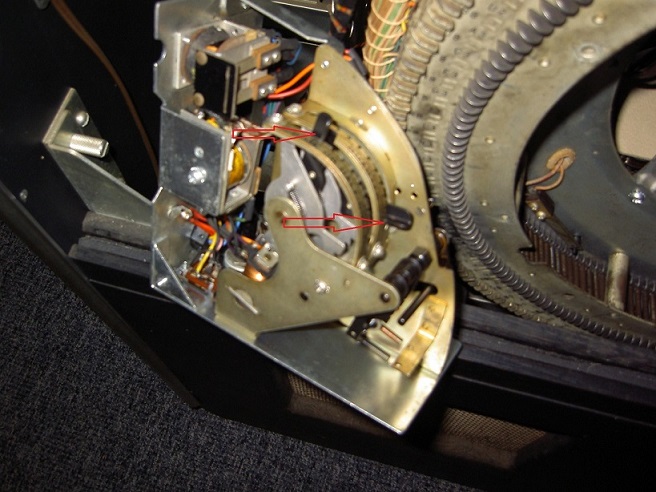
| Die Kreditanzahl kann an den schwarzen Hebeln im Kreditteil eingestellt werden - siehe Foto. | The amounts of credits can be set with the black levers at the credit unit - see photo. |
Foto: Wilhelm Schwarzenberger
Unterschiede im Kreditsystem Wurlitzer 1700 und Wurlitzer 1800 - Information: Axel Rosenberger
Die Kreditwerke von 1700 und 1800 arbeiten definitiv
unterschiedlich.
Wird in eine 1800er z.B. 1 DM eingeworfen, dann fällt die Münze am Ende
des Münzprüfers auf einen Hebel, der einen Mikroschalter betätigt. Dieser
Mikroschalter setzt den Kreditwerksmotor in Gang und es werden z.B. bei 1 DM
sechs Kredite aufgezählt und die Münze fällt in den Kassensack. Bei jeder
Tastenanwahl wird über einen Subtraktionselektromagneten je ein Kredit zurück
gezählt. Der Kreditwerksmotor dreht sich dabei nicht.
Ist der letzte Kredit abgezählt, wird ein Kontakt geöffnet und der
Tastaturmagnet fällt ab.
Wird in eine 1700er z.B. 1 DM eingeworfen, dann fällt die Münze am Ende
des Münzprüfers auf einen Hebel, der einen Mikroschalter betätigt. Dieser
Mikroschalter lässt den Tastaturmagneten anziehen, die Münze bleibt aber am
unteren Ende des Münzprüfers auf besagtem Hebel liegen. Erst wenn die erste Wahl
an der Tastatur durchgeführt wird, setzt sich der Kreditwerksmotor in Gang,
lässt die Münze vom Hebel in den Kassensack fallen, zählt die noch verbliebenen
fünf Kredite auf und bleibt wieder stehen. Bei jeder weiteren Tastenwahl ( noch
fünf Kredite ) beginnt der Kreditwerksmotor erneut zu laufen und die Schleifer
vollziehen eine komplette Umdrehung und dabei wird über eine Art Schlepp - Hebel
ein Kredit abgezählt ( kein Subtraktionsmagnet vorhanden).
Wenn der letzte Kredit abgezählt ist, wird ein Kontakt geöffnet und der
Tastaturmagnet fällt ab.
Die Titelanwahl funktioniert in der 1800 also schneller, als in der 1700.
Das Kreditwerk der 1700 funktioniert exakt, wie die zugehörige Wallbox zur 1700.
The credit unit in models 1700 and 1800
work differently for sure.
If, for example, 1 DM is inserted into an 1800, the coin falls onto a
lever at the end of the coin validator, which activates a microswitch. This
microswitch sets the credit mechanism motor to run and, for example, six credits
are counted for 1 DM and the coin falls into the cash bag. Each time a button is
pressed, a subtract solenoid counts backwards one credit. The credit mechanism
motor does not rotate.
When the last credit has been counted, a contact is opened and the latchbar
solenoid releases.
If, for example, 1 DM is inserted into a 1700, the coin falls onto a
lever at the end of the coin selector, which activates a microswitch. This
microswitch attracts the latchbar solenoid, but the coin remains on the lever at
the lower end of the coin selector. Only when the first selection is made on the
keyboard the credit mechanism motor starts, drops the coin from the lever into
the cash bag, counts up the remaining five credits and stops again. Each time
another button is pressed (five credits remaining), the credit mechanism motor
starts running again and the sliders complete a full rotation, counting off one
credit via a kind of drag lever (no subtract solenoid available).
When the last credit has been counted, a contact is opened and the latchbar
solenoid releases.
The title selection works faster in the 1800 than in the 1700.
The credit mechanism of the 1700 works exactly like the corresponding wallbox
for the 1700.
Die Angaben haben keinen
Anspruch auf Vollständigkeit oder Richtigkeit.
Bei den (importierten) Boxen können im Laufe der Jahre durchaus
Veränderungen vorgenommen worden sein. Copyright.
Ein Service von

Copyright by
Stamann Musikboxen