Bei meiner Lyric (Bj. 1975/76) fängt nach dem Einschalten und nach Zifferneingabe der Plattenkorb nur sehr langsam an sich zu drehen. Er findet aber nach einiger Zeit die Platte, sie wird einwandfrei abgespielt. Je öfter man eine Platte abspielt desto besser dreht der Korb. Auch wenn man den "Freidrehhebel" betätigt, fängt der Korb nur langsam an sich zu drehen und bringt nach einigen Umdrehungen dann aber recht "normale" Geschwindigkeit. Schafft Schmierung Abhilfe? Wo sind die richtigen Stellen zum Schmieren? Dreht man den Korb bei ausgeschalteter Musikbox manuell, ist er auch schwergängig.
Antwort:
Bei der
Wurlitzer ist der Antrieb für den Korb hinten links. Dieser erfolgt über
ein Schneckenrad und dann über ein Gummirad. Wahrscheinlich ist der
Gummiring
nicht mehr griffig genug und sollte ersetzt werden. Ferner lohnt sich
ein Schmieren der Rollen, die den Korb stützen. Allerdings muß man dazu
den Korb ausbauen, was aber kein zu großer Akt ist. Bei dieser
Gelegenheit kann man den Teller von unten entfetten. Mit der Zeit
befindet sich hier - durch die Rollen - Öl und somit hat das
Gummirad keinen Griff mehr.
In my Lyric (built 1975/76),
the record magazin starts to rotate very slowly after being switched on
and a number was entered. However, after a while it finds the record
which gets played without any problems. The more often a record gets
played, the better the magazin rotates. Even if operating the "free
rotation lever", the magazin starts to rotate very slowly, but after a
few rotations it reaches a fairly "normal" speed.
Can lubrication help? Where are the right places to "lubricate"? If you
turn the magazin manually with the jukebox being switched off, it
rotates also quite sluggish.
Answer:
On the Wurlitzer, the drive for the magazin is at the rear left. This is
done via a worm wheel and then via a rubber wheel. The
rubber
ring probably
doesn't have enough grip anylonger and should be replaced. It is also
worth lubricating the rollers that support the magazin. However, you
will have to remove the magazin to do this, which is not too much of a
job. You can use this opportunity to degrease the base from below.
Within times, oil will build up here through the rollers and the rubber
wheel will no longer have any grip.
Der Korb ist schwergängig trotz Reinigen und Ölen, vor allem nach längerer Nicht-Nutzung - Modelle ab 1969
The magazin rotates sluggishly though it was cleaned and lubricated, especially after not using it for some time - models 1969 and up
Öl ist nicht immer gut, vor allem wenn man nicht sieht wo man es
aufträgt.
Rückwand öffnen und den Plattenkorb drehen lassen, dabei den Motor
rechts unter dem Chassis beobachten. Steht man vor der Musikbox, sitzt dieser
hinten links in der Ecke unter dem Chassis. Wenn dieser Motor
gleichmäßig dreht, dann ist wahrscheinlich Öl auf der Lauffläche. Der
Motor treibt über eine Schnecke einen
Gummiring an, welcher unter dem Korb liegt. Wenn da Öl drauf
gekommen ist, reicht oft das Eigengewicht des Korbes nicht mehr aus.
Manchmal ist aber auch einfach der
Gummiring abgenutzt. Dann sollte er ausgetauscht werden.
Es kann auch sein, dass der Motor Laufprobleme hat. Es gab eine Serie, die gerne streikte, weil das Gussmaterial aufblüht. Wenn der Motor also dieses Problem hat, hilft nur Ersatz. Im übrigen ist diese Art von Motoren dankbar, wenn sie ein wenig Öl auf die Filzringe bekommen - oben und unten. Diese sorgen dann dafür, dass die Lagerbuchsen geschmiert werden.
Oil is not always good,
especially if you cannot see where it gets applied.
Open the rear panel and rotate the record magazin while observing the
motor on the right below the chassis. If you are standing in front of
the jukebox, it is in the rear left corner below the chassis. If this
motor rotates evenly, there is probably oil on the rotating surface. The
motor drives a
rubber
ring below the
magazin via a worm gear. If oil has got on it, the weight of the magazin
is often no longer sufficient.
Sometimes, however, the
rubber
ring is simply
worn out. It should be replaced then.
It is also possible that the
motor has running problems. There was a series that liked to "go on
strike" because the cast material breaks out. So if the motor has this
problem, only a replacement will help.
Incidentally, this type of motor is grateful for getting a little oil on
the felt rings - top and bottom. These then ensure that the bearing
bushes are lubricated.
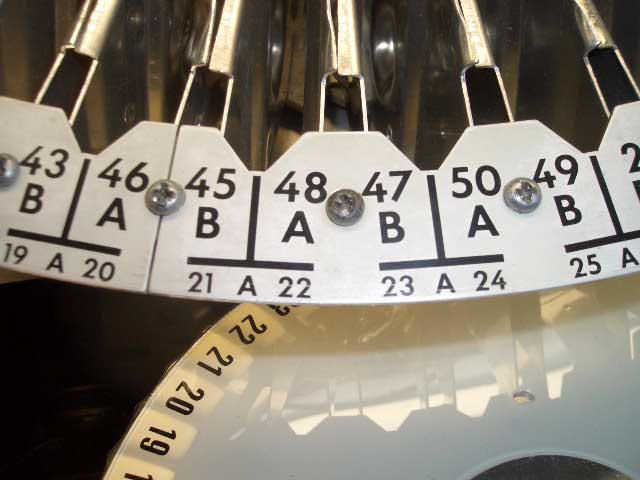
Nummerierung auf dem Plattenkranz - Lyric mit manueller Wahl 1961 - 1969
|
Das Wahlsystem ist etwas schwierig zu
verstehen (der amerikanische 200er Wahlkranz ist übrigens noch
komplizierter). Wenn das Handrad z. B. auf "1" eingestellt ist, wird mit
der "A" - Taste der Pin A1 ausgelöst und der ist auf der äußeren Reihe.
Beim Drücken der "B" - Taste wird natürlich der Pin B1 ausgelöst und der
ist ebenfalls auf der äußeren Reihe aber genau gegenüberliegend. Das ist
auch logisch, denn die Platte B1/B2 ist auch im Magazin genau gegenüber
von A1/A2. |
The selection
system is somewhat difficult to understand (the American 200
selection system is even more complicated). If the handwheel is set
to "1", for example, the "A" button triggers pin A1, which is on the
outer row. Pressing the "B" button of course triggers pin B1, which
is also on the outer row but exactly opposite. This is also logical,
as record B1/B2 is also in the magazine exactly opposite A1/A2. All selection
pins on the outer row correspond to an odd number and all selection
pins on the inner row correspond to an even number. The two arms of
the selector crank are of different lengths, one scans the inner row
and one scans the outer row (the shorter one is shown in the picture).
The arms are also offset by half a record compartment. For example,
if A1 and the back of record A2 are selected, pin A1 is found with
the longer arm of the selector crank. After being played, the
magazine must rotate half a turn until selection pin A2 is found
with the shorter arm, even though it is next to selection pin A1.
The magazine has 50 record compartments, but there are 100 positions
in which the magazine can engage. From A1 to A2 the magazine must
rotate exactly 51 positions. Since the lift arms are also offset by
half a record compartment, the records are lifted from the left to
play the front (odd numbers) and from the right to play the back (even
numbers). |
|
21 A ist die A Seite, 22 A die B Seite |
21 A is the A side,
22 A is the B side |
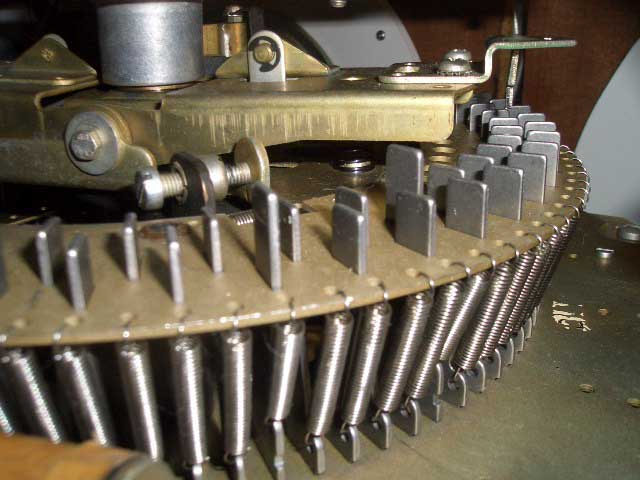
Der Plattenkorb einer OMT dreht direkt nach dem Einschalten unaufhörlich - alle Modelle mit Computer SCC.
Der Plattenkorb dreht sich ununterbrochen und auf dem Display "Record Playing" leuchten keine LEDs. Schalte ich den Selection and Credit Computer (SCC) auf "Service" und drücke die LT Taste, tut sich nichts. Auch Aus- und Anschalten des Gerätes ist ohne Erfolg. Die Leuchtdioden K und Z leuchten ununterbrochen. Steckerverbindungen habe ich überprüft. Gibt es eine Lichtschranke am Plattenkorb? Muss diese leuchten, wenn die Leuchtdioden K und Z permanent an sind?
Antwort: Ja, es gibt eine Lichtschranke. Wenn
Z und K permanent an sind, dann ist sehr wahrscheinlich die Lampe der
Lichtschranke aus und deutet sehr wahrscheinlich auf einen Fadenbruch
hin. Also Lampe kontrollieren, vorne rechts am Korb unter der schwarzen
Abdeckung sollte es leuchten.
Wenn nicht, Lampe wechseln.
The record magazin spins
continuously and no LEDs light up on the "Record Playing" display. If I
switch to "Service" on the selection and credit computer and press the
LT button, nothing happens. Even switching the jukebox off and on again
did not help. The K and Z LEDs light up continuously.
I have checked the plug connections. Is there a light barrier on the
record magazin? Does it have to light up when LEDs K and Z are
permanently on?
Answer: Yes, there is a
light barrier. If Z and K are permanently on, then the miniature lamp of
the light barrier is very probably off and this very probably indicates
a yarn breakage. So check the miniature lamp, it should light up at the
front right of therecord magazin under the black cover.
If not, replace the lamp.
Der Korb einer OMT dreht ununterbrochen und hält nicht bei der gewählten CD an. Alle Vinyl- und CD-Modelle mit SCC ab 1978.
The record magazin rotates continously and does not stop at selected CD. All vinyl and CD models with SCC 1978 onwards.
Der Korb dreht sich ständig, hält aber bei der entsprechenden Auswahl nicht an.
Möglichkeit 1: In diesem Fall bitte zunächst die Lichtschranke vorne am CD-Korb prüfen. Die LEDs "Z" und "K" an der SCC-Steuerung müssen beim Drehen des Korbes blinken. "Z" pro CD, "K" einmal pro komplettem Umlauf.
.jpg) Sollten beide LEDs dauerhaft leuchten, ist vermutlich die Lichtschranke defekt. Diese befindet
sich unter einer kleinen Abdeckung vorne am CD-Korb, dort, wo die Zähne
des Korbes durchlaufen. Diese prüfen und ggfs. wechseln.
Es ist die Glühlampe
Ba7s 24 Volt 3 Watt.
Sollten beide LEDs dauerhaft leuchten, ist vermutlich die Lichtschranke defekt. Diese befindet
sich unter einer kleinen Abdeckung vorne am CD-Korb, dort, wo die Zähne
des Korbes durchlaufen. Diese prüfen und ggfs. wechseln.
Es ist die Glühlampe
Ba7s 24 Volt 3 Watt.
Möglichkeit 2: defekte
Transistoren in der SCC 40315 bei Seriennummern von 3108 ... bis 3207
....

Siehe folgendes pdf.
SI-MA 48
The record magazin is constantly rotating but does not stop at the selected selection.
Possibility 1: In this case, first check the light barrier at the front of the CD basket. The "Z" and "K" LEDs on the SCC selection and credit computer must flash when the magazin rotates. "Z" per CD, "K" once per complete rotation.
If both LEDs light up continuously, the light barrier is probably defective.
This is located underneath a small cover at the front of the CD magazin,
where the teeth of the magazin pass through. Check this and replace if
necessary. This is the miniature lamp
Ba7s 24 Volt 3 Watt.
Possibility 2: Defective
transistors in the SCC 40315 for serial numbers from 3108 ... to 3207
....
See the following pdf.
SI-MA 48
Die Angaben haben keinen
Anspruch auf Vollständigkeit oder Richtigkeit.
Bei den (importierten) Boxen können im Laufe der Jahre durchaus
Veränderungen vorgenommen worden sein. Copyright.
Ein Service von

Copyright by
Stamann Musikboxen