►►► Greifermotor |
|
Gripper Motor |
|
Öffnen und Reinigen eines Greifermotors - auch für den Magazinmotor
(Korbmotor) passend |
|
Opening and cleaning a gripper motor -
also valid for magazine motor (basket motor) |
|
Wie öffne ich den Motor meiner Rock-Ola 1465? Wenn ich die hinteren zwei
Schrauben des Deckels löse, kann ich den Deckel nur ansatzweise abheben,
der Kollektor hängt noch irgendwie dran. Muss ich jetzt sonst noch etwas
lösen, um an die Innereien des Motors zu kommen oder nur "beherzter" den
Deckel abhebeln?
Antwort 1:
In diesem Falle lieber nicht beherzt! So wie es sich anhört, sind
die Kohlen noch nicht herausgenommen. Sind die Kohlen raus, versuche den Anker
direkt zu fassen und ihn herauszuziehen. Es kann sein, dass er an der
Schnecke vorne am Anker hängt, oder ein Lager löst sich nicht. Aufpassen
musst Du vor allem, dass beim Herausziehen die Wicklung nicht beschädigt
wird.
►►► Vor dem Herausziehen des
Ankers muß beim Greifermotor erst noch der Pertinax-Kohlenhalter
weggenommen werden!
Also: der Deckel muss zuerst runter und sollte auch runtergehen, während
der Anker noch in seiner Position bleibt. Die Kohlen können
sicherheitshalber vorher entfernt werden, sind dem Deckel aber
grundsätzlich nicht im Weg.
Vielleicht geht das Gleitlager etwas streng über das Ende der Welle?
Reinigen des Kollektors, Reinigen und Ölen des Gleitlagers nicht
vergessen, den Ölfilz um die Lagerbuchse mit Öl versehen (wird bestimmt trocken sein, am besten
dazu herausnehmen dazu). Der Kollektor muss
ölfrei bleiben !!!
Die Kohlen richtig einsetzen, so daß sich die eingelaufene Rundung
wieder der Oberfläche des Kollektors anschmiegt. Sie sollen auch gut
gleiten können in ihrer Führung.
Vor dem Einbau sollte der Motor Probe laufen, dabei die
Drehrichtung und die Stromaufnahme
checken: sie sollte deutlich unter 1 A bleiben.
Antwort 2:
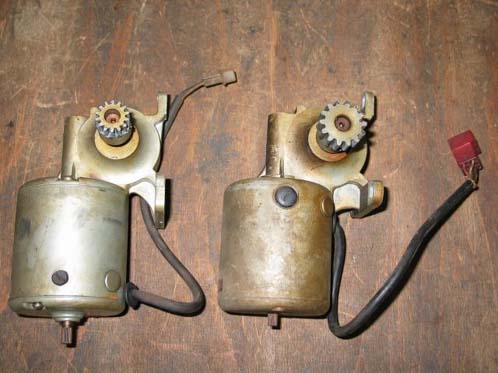
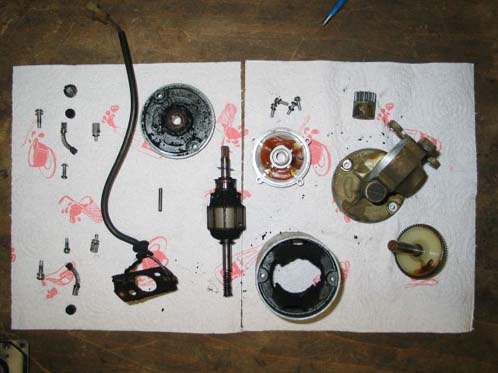
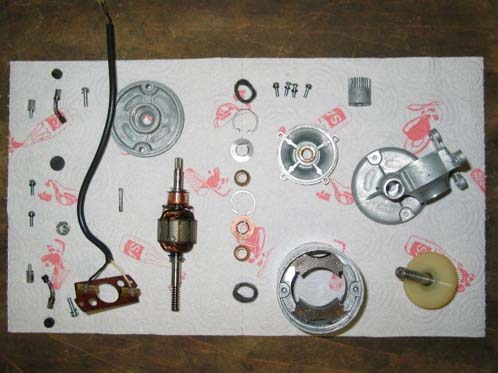
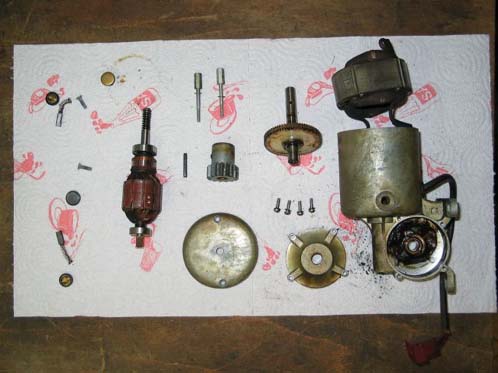
Zerlege den Greifermotor durch
Entfernen der beiden Motorkohlen (schwarze Schraubkappen an der Seite),
damit auf die Einbaulage achten und Lösen der Schrauben an der
Unterseite. Untere Kappe vom Gehäuse entfernen und Anker (Läufer)
vorsichtig herausziehen. Achte darauf, dass die Kupferwicklungen
des Ankers nicht beschädigt werden und dass die Abstandsscheiben nicht
verloren gehen. Jetzt die beiden Schrauben am Getriebe lösen und
Getriebe vom Gehäuse entfernen. Teste mal, ob das Getriebe leichtgängig
ist, indem Du am Zahnrad drehst. Zahnrad muss sich gleichmäßig bewegen
lassen. Wenn ja, lass das Getriebe zu. Gehäuse und Bodendeckel vom
Kohlstaub und Dreck befreien. Dies am besten mit einer 100% Lösung Isopropanol (bekommst Du in der Apotheke) reinigen.
Jetzt zum Anker: Befindet sich ein Kugellager auf dem Anker? Ist dies
leichtgängig? Wenn nein, das Lager (nicht den kompletten Anker) mit
Bremsenreiniger (Autobedarf) mehrfach einsprühen, bis der Dreck raus
ist. Das Lager muss sich dann wieder leicht drehen können. Wenn nein,
müsste es neues Lager drauf. Dieses gibt es hier bei
Stamanns.
Leider lässt sich das alte Lager nur sehr schwer von der Achse lösen.
Und dies solltest Du nicht tun, wenn Du Laie bist.
Achse des Ankers und Abstandsscheiben ebenfalls reinigen.
Am Ende des Ankers befindet sich eine Kupferbahn, die mehrfach geteilt
ist. An dieser wird der Strom über die Motorkohlen auf den Anker
übertragen. Ist die Bahn stark eingelaufen? Wenn nein, Glück gehabt.
Wenn ja, macht es der Motor nicht mehr allzu lange. Sind die Teilungen
der Kupferbahn mit Kohlestaub und Dreck zu? Das sind sie es eigentlich immer. Reinige
diese Teilungen mit Isopropanol und Wattestäbchen. Oder vorsichtig mit
einer Nadel ohne die Bahn zu beschädigen. Wenn zusätzlich die Bahn
Riefen hat, Anker in eine Bohrmaschine einspannen, dabei Achse nicht
beschädigen!!! Anker muss zentriert sitzen, darf also nicht pendeln.
Dann mit sehr (!) feinen Schleifpapier (Körnung größer 600) die
Kupferbahn abziehen. Danach kontrollieren, ob keine Kupferteilchen in
den Teilungen sitzen.
In umgekehrter Reihenfolge wieder zusammenbauen.
Kontrollieren, ob Achse sich leicht drehen lässt. Dazu an der Rändelung
der Achse, die aus dem Bodendeckel ragt, drehen.
Motor prüfen, indem Du ihn an die Musikbox anschließt und ohne ihn
festzuschrauben, einfach mal drehen lässt.
Wenn er rund und recht leise läuft, müsste er auch nach dem Einbau das
tun, wozu er gebaut ist.
►►► Nach dem Reinigen sollten
die Zwischenräume der Lamellen gut gereinigt werden, da sich dort gern
Kohlenstaub oder nach dem Abdrehen sogar Späne sammeln. Diese leiten
dann - eine Fehlfunktion ist die Folge.
Zudem muss das Lager gut ausgerichtet sei. |
|
How do I open the motor
of my Rock-Ola 1465? When I loosen the two screws at the back of
the cover, I can only lift the cover to some extent, the
collector is still attached somehow. Do I have to loosen
anything else to get to the insides of the motor or just lift
the cover off more “courageously”?
Answer 1:
In this case, it's better not to be courageous! Your
descriptions sounds, that the carbons have not been removed yet.
When they are removed, try to grasp the armature directly and
pull it out. It may be that it is hanging on the screw at the
front of the armature, or a bearing is not coming loose. Be
especially careful to not damage the winding when pulling it
out.
►►►
Before pulling out the armature, the Pertinax carbon holder must
first be removed from the gripper motor!
So:
The cover must come off first and should also come off while the
armature remains in its position. To be on the safe side, the
carbons can be removed before the cover is removed, but they are
not in the way of the cover.
Perhaps the plain bearing is a little tight over the end of the
shaft?
Don't forget to clean the commutator and clean and oil the plain
bearing, apply oil to the oil felt around the bearing bushing (it
will certainly be very dry, best to remove it for this purpose...).
The collector must remain oil-free !!!
Insert the carbons correctly, so that the worn rounding fits the
surface of the collector again. They should also be able to
slide easily in their guidance.
Before installation, you should test run the motor and check the
direction of rotation and the
current consumption:
It should remain well below 1 A.
Answer 2:
Dismantle the gripper motor by removing the two motor carbons (black
screw caps on the side), paying attention to the installation
position and loosening the screws on the underside. Remove the
lower cap from the housing and carefully pull out the armature (rotor).
Make sure that the copper windings of the armature are not
damaged and that the spacers are not lost. Now loosen the two
screws on the gearbox and remove the gearbox from the housing.
Test whether the gearbox runs smoothly by turning the gear wheel.
The gear wheel must move smoothly. If so, close the gearbox.
Remove carbon dust and dirt from the housing and base cover.
This is best to do with a 100% solution of isopropanol (available
from the chemist).
Now to the armature: Is there a ball bearing on the armature? Is
it running smoothly? If not, spray the bearing (not the complete
armature) several times with brake cleaner (automotive supplies)
until the dirt is removed. The bearing should then be able to
rotate easily again. If not, a new bearing should be fitted.
This is available here at
Stamanns.
Unfortunately, the old bearing is very difficult to remove from
the axle. And you should not do this if you are a layperson.
Also clean the
armature axle and spacers.
There is a copper track at the end of the armature, which is
divided several times. This is where the current is transmitted
to the armature via the motor brushes. Is the track badly worn?
If not, good luck for you.
If yes, the motor won't last much
longer. Are the
partitions
of the copper track
soiled with carbon
dust and dirt? They are so actually always. Clean these partitions with
isopropanol and cotton buds. Or carefully with a needle without
damaging the track. If the track is also scored, clamp the
armature in a drill without damaging the axle!!! The armature
must be centered, i.e. it must not oscillate. Then turn down the
copper track with very (!) fine sandpaper (grain size greater
than 600). Then check that no copper particles stay in the
partitions.
Reassemble in reverse order.
Check whether the shaft can be turned easily. To do this, turn
the knurling on the axle that protrudes from the base cover.
Check the motor by connecting it to the jukebox and simply letting
it turn without tighten is already.
If it runs smoothly and quietly, it should what it was
designed for also after the re-installation.
►►►
After cleaning, the spaces between the vanes should be cleaned
well, as carbon dust or even shavings tend to collect there
after turning. These then become conductive and cause a
malfunction.
The bearing must also be well aligned. |
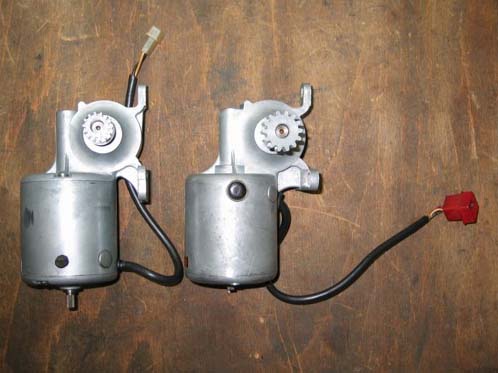
Bilder: Axel Rosenberger

|
| |
|
Stromaufnahme Greifermotor |
|
Current consumption gripper motor |
Wie hoch ist die Stromaufnahme eines
intakten Greifermotors z.B. in einer Rock-Ola Tempo? Das
Getriebe ist an sich leichtgängig, zusammengebaut jedoch schwergängig.
Er zieht 2,2A.
Antwort:
2,2 A ist viel zu viel ... Bei 1,6 A sollte die entsprechende Sicherung im
Netzteil ansprechen. Wenn der Motor mechanisch schwergängig ist bzw.
etwas klemmt, ist die Stromaufnahme natürlich deutlich höher. Gute
Motoren (mit Feldwicklung) ziehen ca. 500 - 800 mA.
Sicherungen in der Musikbox prüfen, wenn bisher noch keine
durchgebrannt ist. |
|
What is the current consumption of an intact
gripper motor, e.g. in a Rock-Ola Tempo? The gearbox itself runs
smoothly, but is stiff when assembled. It draws 2.2A.
Answer:
2.2 A is way too much ... At 1.6 A, the corresponding fuse in the power
supply unit should trip. If the motor is mechanically stiff or jammed,
the current consumption is of course significantly higher. Good motors (with
field winding) draw approx. 500 - 800 mA.
Check
fusesin your jukebox if none did blow
so far. |
| |
|
Greifer bewegt sich nur sehr langsam |
|
Gripper arm moves very slowly only |
|
Bei einer RO 433 (GP
Imperial) bewegt sich der Greifer für die Platten nur sehr langsam. Es
dauert vom Greifen der Platte bis zum Auflegen ca. 30 Sekunden. Beim
Zurücklegen der Platte bewegt sich der Plattenarm etwas schneller.
Die Mechanik am Malteserkreuz wurde gereinigt, sie läuft mit ausgebautem
Greifermotor sehr leicht.
Der Greifermotor wurde gereinigt und mit neuen Schleifkohlen versehen.
Der Anker sieht sehr gut aus.
Wo liegt das Problem?
Antwort - mögliche Ursachen:
Mechanisch: es befindet sich noch Fett in den Lagern,
der Spindel und am Zahnrad. Dieses sollte gründlich gereinigt werden,
das das klebrig und feste Fett den Motor unnötig bremst und belastet.
Ebenso sollten die Kugellager überprüft werden.
Elektrisch:
messen der ankommende Spannung - welcher Wert liegt vor? Es könnte sein,
dass die Musikbox im abgebremsten Zustand läuft. Die Rock-Ola Motoren
bremsen mittels eines Mikroschalters zu dem Zeitpunkt des Aufsetzens des
Tonarmes mit einem Lastwiderstand ab, damit dieser sanft aufsetzt. Diese
Regler sind oft jahrelang nicht bewegt worden und funktionieren somit
nicht einwandfrei. Ist der Mikroschalter defekt, arbeitet der Motor die
ganze Zeit im abgebremsten Modus.
|
|
In a RO 433 (GP Imperial), the gripper arm for
the records moves very slowly. It takes approx. 30 seconds from gripping
the record to placing it on the turntable. When the record is put back,
the gripper arm moves a little faster.
The mechanism of the gripper ioint was cleaned, it runs very smoothly
with the gripper motor removed. The gripper motor was cleaned and fitted
with new carbon brushes. The armature looks very good. What is the
problem?
Answer - possible causes:
Mechanical: There is still grease in the
bearings, the spindle and on the gearwheel. This should be cleaned
thoroughly, as the sticky and solid grease unnecessarily slows down
and stresses the motor. The ball bearings should also be checked. Electrical: Measure the incoming voltage -
what is the value? It could be that the jukebox is running in a
braked state. The Rock-Ola motors use a microswitch to brake the
tonearm with a load resistor when it touches down so that it touches
down gently. These controllers have often not been moved for years
and therefore do not function properly. If the microswitch is
defective, the motor operates in braked mode the whole time.
|
| |
|
Greifermotor ölen |
|
Oiling gripper motor |
|
Das Getriebe des Motors ist nicht ölgefüllt.
Geölt wird der Motor über zwei Bohrungen auf den Lagerschalen. Diese
führen zu einem Filzring, der das Sinter-Gleitlager umgibt und das Öl
nach und nach durch die Poren des Sinterlagers an die Gleitfläche
bringt. Auf den Getriebedeckeln sind zwei ovale Stahlplättchen
eingelassen. Hier wird ebenfalls in die beiden Bohrungen etwas Öl
gegeben zur Schmierung der schnell laufenden Getrieberäder.
|
|
The motor gearbox is not filled with oil. The
motor is oiled via two holes on the bearing shells. These lead to a felt
ring that surrounds the sintered plain bearing and gradually brings the
oil to the sliding surface through the pores of the sintered bearing.
Two oval steel plates are embedded in the gearbox covers. Some oil is
also poured into the two holes to lubricate the high-speed gear wheels. |
|
►►►
Korbmotor, Magazinmotor |
|
Magazine Motor |
|
Korbmotor läuft deutlich zu schnell |
|
Magazine motor runs significant too fast |
Bisher lief die Regis problemlos, auffällige Geräusche sind dabei nicht
zu hören. Nun passiert folgendes:
-
Musikbox eingeschaltet, Kredit vorhanden, drei Wahlen getätigt
-
erste Wahl wird einwandfrei gespielt und zurückgelegt
-
der Korbmotor läuft für die zweite Auswahl wieder an, wird aber immer schneller
und läuft damit deutlich zu schnell (fast doppelt so schnell)
-
die noch ausstehenden Wahlen werden nicht mehr genommen
Antwort:
Der Korbmotor dreht unkontrolliert zu schnell, wenn die Feldwicklung
unterbrochen ist bzw. die Versorgungsspannung davon fehlt. Es empfiehlt
sich, den Mikroschalter Nr. 2 (links neben dem Greifermechanismus) sowie
den 22 Ohm Widerstand zu testen, der sich in der Controlbox befindet.
Es könnte auch sein, dass ein kleiner Pin am Motorstecker beim
Einstecken ins Plastikgehäuse etwas zurückgerutscht ist. Das verursacht
ebenfalls Kontaktprobleme zur Feldwicklung. |
|
So far the Regis did work troublefree, no
remarkable noises could be heard. Now this happens:
- Jukebox switched on, credit established,
three seelctions made
- the first selection gets played fine and
the record returned
- the magazine motor starts for the next
selection but then gets faster and runs significant too fast (about
two times fast)
- the remaining selections are not taken
anymore
Answer:
The magazine motor rotates uncontrollably too fast if the field winding
is interrupted or the supply voltage is missing. It is recommend to test
microswitch no. 2 (to the left of the gripper mechanism) and the 22 Ohm
resistor located in the control box.
It could also be that a small pin on the motor connector has slipped
back slightly when plugged into the plastic housing. This also causes
contact problems with the field winding. |
| |
|
Ausbau
Korbmotor - Bsp. Tempo 2 |
|
Removal of magazine motor - for example in
Tempo 2 |
|
Es sind drei Schrauben unter dem Chassis zu entfernen,
passend ist ein 11er Werkzeug (7/16"). Eine ist am Kopf des Motors und zwei
befinden mittig links und rechts daneben. Man kommt am besten an die
drei Schrauben, wenn man einen Ratsche mit Verlängerung und eben die
11er Nuss verwendet. Der Motor ist auch noch abzustecken. |
|
There are three screws to remove under the chassis,
an 11 mm tool is suitable (7/16"). One is at the top of the motor and
two are in the middle to the left and right of it. The best way to get
to the three screws is to use a ratchet with extension and the 11 mm
socket.
The motor also needs to be unplugged. |
| |
|
Korbmotor (und somit Plattenmagazin)
läuft sporadisch rückwärts - Tempo 2 und
vergleichbare |
|
Magazine motor (and hence the magazin) runs
backwards randomly - Tempo 2 and similar |
|
Nach dem Zurücklegen der Single kommt es
manchmal vor, dass das Plattenmagazin rückwärts läuft, also in die
falsche Richtung. Es ist kein Muster erkennbar.
Antwort:
Eine mögliche Ursache ist, dass die
Feldwicklung des Korbmotors sporadisch ausfällt und dann nur der Anker
im Stromkreis liegt. Fehlerquelle dafür ist wahrscheinlich Mikroschalter
Nr. 2, der nicht sauber öffnet und schließt.
Ausgeleierte Steckkontakte an der Motor-Steckdose der Controlbox können
diesen Fehler ebenso verursachen. |
|
After returning the record it happens sometimes
that the magazin turns backwards, means in the wrong direction. A
pattern for this behavior can't be recognized.
Answer:
One possible cause is that the field winding of the magazine motor fails
sporadically and then only the armature is in the circuit. The source of
the fault is probably microswitch no. 2, which does not open and close
properly.
Worn-out plug contacts on the motor socket of the control box can also
cause this fault. |
|
►►► Plattentellermotor |
|
Turntable Motor |
|
Der Plattentellermotor wird im normalen
Betrieb bei 220V sehr heiß. |
|
The turntable motor gets hot in normal
operation at 220V. |
|
Als erstes sollte geprüft werden, ob es sich
um einen 50Hz. oder 60 Hz. Motor handelt. Der 50 Hz. Motor sollte im
Vergleich etwas kühler bleiben. Der 60 Hz. Motor wird, da er in Europa
nur mit einer Frequenz von 50 Hz. betrieben wird, wärmer. Dabei kann die
Temperatur deutlich über Handwärme liegen.
Der Motor sollte zerlegt, gereinigt, und im
Lager geölt sein. Verschmutzte Motoren laufen schwergängig und können
dadurch wärmer als gewöhnlich werden. Bei Motoren bis Modell Rock-Ola
443 wurde durch Distanzhülsen verhindert, dass die Schrauben in die
Wicklung des Motors gedreht werden konnten und somit die Wicklung
beschädigen. Beschädigte Wicklungen führen zu Beeinträchtigungen, was
sich in Form von höherer Wärmeentwicklung bemerkbar macht (bevor die
Wicklung einen Kurzschluß verursacht).
Generell kann man bei den verschiedenen Plattentellermotoren im Laufe
der Jahre unterschiedliche Wicklungswiderstände messen. Ein intakter
Motor sollte so um die 200 Ohm Wicklungswiderstand besitzen.
Laufen tun diese Motoren auch noch mit 150 Ohm oder auch darunter, aber
sie werden sehr heiß, weil weniger Wicklungswiderstand bei einer festen
Spannung einen höheren Strom bedeutet.
Abhilfe: Man kann durch einen entsprechenden Vorwiderstand in Reihe
zur Wicklung den Strom drosseln und somit die übermäßige Erwärmung
reduzieren. Dies hat z.B. Wurlitzer bei seinen mit 60 Hz
Plattentellermotoren ausgerüsteten 1950er Jahre Modellen so gemacht -
ein 75 Ohm 10 Watt Widerstand wurde zusätzlich eingebaut.
Handwarm = ~ 30°C
Heiß = zu heiß zum Anfassen = ab ~ 60°C
|
|
The first thing to check is whether it is a 50Hz.
or 60 Hz. motor. The 50 Hz. Motor should remain somewhat cooler in
comparison. The 60 Hz. motor will become warmer, as it is only operated
at a frequency of 50 Hz in Europe. The temperature can be well above
warm to the touch.
The motor should be disassembled, cleaned and the bearings oiled. Dirty
motors run sluggishly and can therefore become warmer than usual. On
motors up to model Rock-Ola 443, spacer sleeves were used to prevent the
screws from being turned into the winding of the motor and thus damaging
the winding. Damaged windings lead to impairment, which is noticeable in
the form of higher heat development (before the winding causes a short
circuit).
In general, different winding resistances can be measured for the
different turntable motors used within the years. A good motor should
have a winding resistance of around 200 ohms.
These motors can still run with 150 ohms or even less, but they will get
very hot because less the winding resistance at a fixed voltage the
higher the current will get.
Remedy: A suitable resistor in series with the winding can be
used to throttle the current and thus reducing excessive heating.
Wurlitzer, for example, did this with its 1950s models equipped with a
60 Hz turntable motor - a 75 Ohm 10 Watt resistor was installed extra.
Hand warm = ~ 30°C / 86°F
Hot = too hot to touch = from ~ 60°C / 140°F |
|
Die Angaben haben keinen
Anspruch auf Vollständigkeit oder Richtigkeit.
Bei den (importierten) Boxen können im Laufe der Jahre durchaus
Veränderungen vorgenommen worden sein. Copyright.
<<<
zur
Archiv Startseite
|
|
Ein Service von

Copyright by
Stamann Musikboxen |