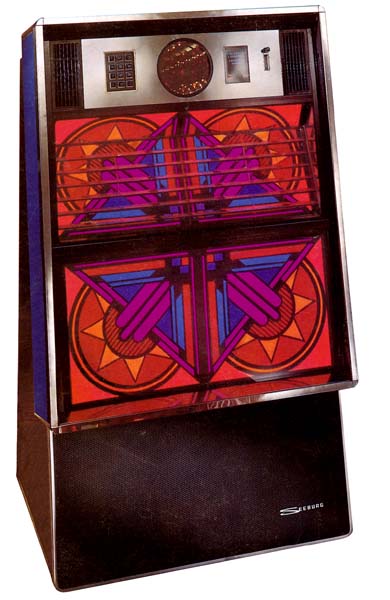
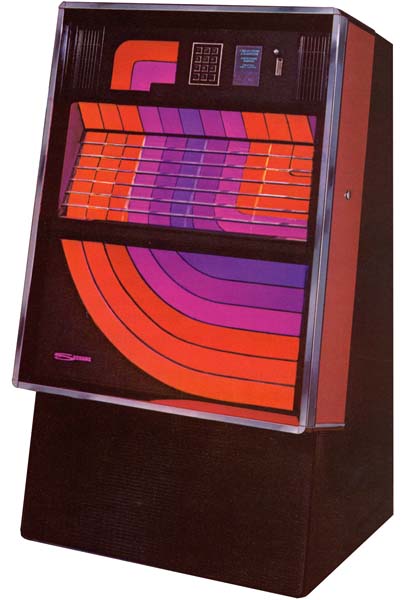
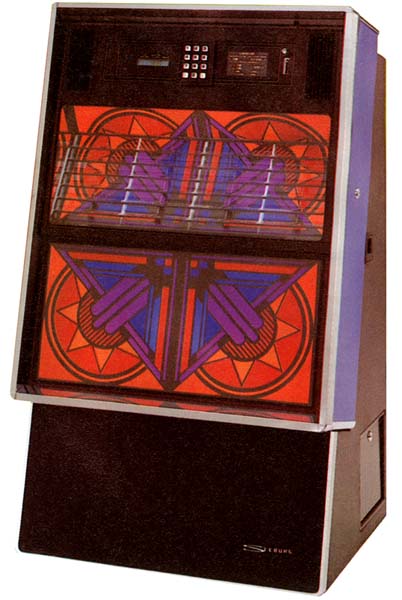
|
Ich war in Frank
Adams Buch „Seeburg Jukeboxes 1927 - 1989“ auf einen Satz
gestoßen, in dem erwähnt wurde, dass die Musikbox SMC1 Jr. der
100-78D Celestia ähnelte. Die Celestia war mir bekannt, da sie
die von mir entworfene „Red Box“ verwendete. Mir war auch
bekannt, dass die MCU-Platine über einen Jumper verfügte, der
auf 50 oder 80 Platten eingestellt werden konnte, wodurch es
möglich war, eine Version der SMC mit 100 Titeln zu bauen. Doch
ich hatte noch nie eine solche gesehen oder davon gehört, obwohl
ich regelmäßig mit Mitarbeitern der Seeburg-Abteilung sprach und
ziemlich oft zum Werk in der Diversey Avenue fuhr. Im Jahr 1996
besorgte ich mir ein Exemplar des „Always Jukin’ Official Guide
to Collectible Jukeboxes“. Beim Durchblättern dieses Leitfadens
stieß ich auf ein Foto einer Discotheque-Version der U100
Mustang von 1964 (genannt U100D); die Bildunterschrift besagte,
es handele sich um einen SMC1 Jr. von 1979. Ich wusste, dass
dies falsch war, also schrieb ich einen Brief an Mike Baute von
Always Jukin’ und wies auf den Fehler hin. Mein Brief wurde in
der Ausgabe von AJ des folgenden Monats abgedruckt. Doch das
weckte mein Interesse. Könnte es sein, dass Seeburg tatsächlich
einen SMC1 Jr. gebaut hatte, ohne dass ich davon wusste? Wie
sich herausstellte, war genau das der Fall.
Ich konnte dies zwar durch keine der
Personen bestätigen, die damals dabei waren, aber das ist meine
Vermutung: Als Seeburg in Konkurs ging, muss noch ein
beträchtlicher Lagerbestand an Modellen der 100-78D und 100-79M
übrig geblieben sein, und diese Teile wurden wahrscheinlich in
das Werk in der Diversey Avenue verlegt. Obwohl die beiden
Modelle völlig unterschiedliche Steuerungssysteme verwendeten,
hatten sie den Großteil der Teile gemeinsam, darunter sogar die
meisten Gehäuseteile. Der einzige Unterschied zwischen den
Gehäusen besteht in der oberen Blende, an der die Auswahltasten,
das Anzeigenfenster und der Münzeinwurf angebracht sind. Dies
und die Tatsache, dass das Modell 100-79M offenbar nie auf
Fachmessen ausgestellt wurde und offenbar nur eine
deutschsprachige Broschüre gedruckt wurde (Stella, der deutschen
Vertriebspartner von Stern/Seeburg), ist wahrscheinlich der
Hauptgrund für die Verwechslung. Wenn man sich diesen Bereich
auf einem Foto nicht genau ansieht, könnte man die beiden
Modelle sehr leicht verwechseln, zumal die Gehäusegrafiken
identisch sind. Es scheint wahrscheinlich, dass Seeburg
Engineering die Vorbereitungen für die Produktion dieses Modells
noch vor der Insolvenz abgeschlossen hatte, da die Änderungen
minimal sind. Im Inneren handelt es sich bei dem Mechanismus um
eine 100er-Version des in der SMC-Serie verwendeten Mechanismus,
wobei bis auf das Grundgussteil und die Anzahl der
Datensatztrenner im Magazin alle Teile identisch sind. Die
einzigen weiteren internen Unterschiede zwischen der 100-78D und
der 100-79M sind die Verkabelung, der Austausch der
Steuerzentrale PPC1 durch eine PCC3, der Wegfall der „Red Box“
sowie der Einbau des CPA-Chassis an der Vorderseite der
Verstärkerabdeckung.
Äußerlich besteht
der einzige Unterschied zwischen den beiden Geräten darin, dass
das Bedienfeld des Modells 100-78D verchromt ist und den
DES100-Wahlschalter, die Anzeige für Guthaben und die erste
Ziffer, den Münzeinwurf sowie eine dekorative Lampenanzeige
beherbergt, bei der dieselben kleinen Lampen zum Einsatz kommen
wie bei der FC1 Regency und den Nachfolgemodellen. Dieses
Bedienfeld wurde durch ein schwarz lackiertes Bedienfeld
ersetzt, an dem die MCU-Tastatur/Display, der Münzeinwurf und
ein Anzeigefenster für Preise usw. angebracht sind.
Ich glaube, Stern
hat vielleicht etwa hundert dieser Modelle gebaut - gerade
genug, um die Restbestände von Seeburg aufzubrauchen.
Wahrscheinlich haben sie einige für dieses Modell spezifische
Teile (z. B. das 100-Wahlen-Grundgussteil) gekauft, um den
Lagerbestand so auszugleichen, dass nach Fertigstellung gerade
noch genug Vorrat übrig war, um Ersatzlieferungen vor Ort zu
gewährleisten. Es scheint, dass der Großteil dieser Automaten
nach Europa ging, was dazu beitrug, dass sie hier in den USA
relativ unbekannt sind. Mir sind jedoch mindestens zwei Modelle
hier in den USA und eines in Australien bekannt. |
|
I had come across a
sentence in Frank Adams book "Seeburg Jukeboxes 1927 - 1989"
that mentioned that the SMC1 Jr. jukebox resembled the 100-78D
Celestia. I was familiar with the Celestia, since it used the
Red Box I designed. I was also aware of the fact that the MCU
board had a jumper that could be set for 50 or 80 records,
making it possible to build a 100-selection version of the SMC.
But I had never seen or heard of one, even though I had frequent
conversations with people in the Seeburg Division, and traveled
down to the Diversey Avenue plant fairly often.
I got a copy of the "Always Jukin' Official Guide to Collectible
Jukeboxes" back in 1996. In thumbing through this guide, I came
across a photograph of a Discotheque version of the 1964 U100
Mustang (called the U100D); with a caption that stated it was a
1979 SMC1 Jr. I knew this to be incorrect, so I fired off a
letter to Mike Baute of Always Jukin', noting the error. My
letter was printed in the following month's issue of AJ. But
this got my interest up. Could it be that Seeburg actually
built an SMC1 Jr., without me knowing about it? Turns out, that
is exactly what happened.
I've not been able to confirm this with any of the people who
were there at the time, but here goes:
A fair amount of inventory for the 100-78D/100-79M models must
have been left over when Seeburg went bankrupt, and these parts
were probably moved to the Diversey Avenue plant. While using
entirely different control systems, the two models shared the
vast majority of parts, even including most cabinet parts. The
only difference between cabinets is the upper panel mounting the
selector buttons, instruction window, and coin entry. This, and
the fact that the 100-79M was apparently never displayed at any
industry shows and evidently only had a German-language brochure
printed (by Stern/Seeburg's German distributor, Stella), is
probably the root cause of the confusion. If you don't look
closely at that area of a photograph, it would be very easy to
confuse the two, especially since the cabinet graphics are
identical. It seems probable that Seeburg Engineering completed
the preparations of this model for production prior to going
bankrupt, since the changes are so minimal.
Internally, the mechanism is a 100-selection version of the one
used in the SMC series, sharing all parts except the base
casting and the number of record separators in the magazine. The
only other internal change between the 100-78D and 100-79M is
the cabling, replacement of the control center PPC1 with a PCC3,
the deletion of the Red Box, and the installation of the CPA
chassis on the front side of the amplifier shield.
Externally, the only
difference between the two machines is that the selection
control panel on the 100-78D is chrome-finished and mounts the
DES100 selector, credit/1st digit lamp display, coin
entry, and a decorative lamp display using the same small lamps
as were used in the FC1 Regency and follow-on models. This
panel was replaced with a black-finished panel mounting the MCU
keyboard/display, coin entry and an instruction window showing
pricing, etc.
I believe Stern
built maybe a hundred or so of these machines, just enough to
exhaust whatever inventory was left over from Seeburg. Probably,
they bought a few parts specific to this model (100-selction
base casting, etc.) to balance inventory so that when they were
done, there was just enough inventory left to support field
replacements. It seems that the majority of these went to
Europe, contributing to them being relatively unknown here in
the U.S. But, I am aware of at least two machines here in the
States, and one in Australia.
Tony Miller
is a late Seeburg engineer and he published many Seeburg
information. He passed away (too young) in 2009.
Luckily his
information can still be found:
https://seeburghistory.jukeboxhistory.info/index.html
https://seeburghistory.jukeboxhistory.info/smc1_jr.html |