|
Bei meiner Rock-Ola Comet 1438 funktionieren 30 Selektionen nicht mehr, und
dies in Zehnerschritten: 11-20, 71-80 und 91-100. |
|
In my Rock-Ola 1438 here are 30 selections
which do not work anymore - and this in increments of ten: 11 -20,
71-80, and 91-100 |
|
Grundsätzlich dürfte es sich um ein einfaches Kontaktproblem oder
einen Kabelbruch handeln.
Die Musikbox schaltet über Kontakte der Titelwalze
in 30er-Gruppen die Tastatur um. D.h. in der ersten Gruppe kann man die
Titel 1 bis 30 anwählen, in der zweiten die Titel 31 bis 60 usw.
Die Wahlen 11-23 und 71-80 liegen genau in der Mitte der Wahlmöglichkeiten
zu je 30 Stück. 91 bis 100 ist der erste Zehnerblock der vierten Gruppe
und fällt leider aus der Systematik heraus.
In jedem Fall schaue Dir einmal die Kabel von der Tastatur zur
Titelwalze an und ebenfalls die Kontakte an der Walze. Ich vermute hier
die Defekte.
Die Verkabelungsmatrix der Comet ist wie folgt aufgebaut:
Zur Tastatur und Titelwalze:
30 Nummerntasten, aufgeteilt in ungerade Nummern
(Stecker/Buchse mit rotem Punkt innen in der Tür rechts) und gerade Nummern
(Stecker/Buchse mit grünem Punkt innen in der Tür rechts).
Wegen der Titelwalze also 4 Gruppen mit 30 Nummern....
Folgende Gruppen bilden sich:
1. Walzenstellung:
01-10 11-20 21-30
2. Walzenstellung:
31-40 41-50 51-60
3. Walzenstellung:
61-70 71-80 81-90
4. Walzenstellung:
91-100 101-110 111-120
Zum Selector:
Dieser hat 20 "Nummernanschlüsse" - 10 ungerade Zahlen vom "roten" Stecker und
10 gerade Zahlen vom "grünen" Stecker.
Diese 20 Nummern sind 20er-gruppenweise am Selector durchgeschleift und
werden durch Umschalten (machen die Kontakte seitlich an der Titelwalze)
von 6 Gruppenrelais (= Clappercoils) jeweils gruppenweise auf Masse
geschaltet.
Daher 6 Gruppen mit 20 Nummern:
01-20 | 21-40 | 41-60
| 61-80 | 81-100 | 101-120
Clappercoil: A B C D E F
Fazit:
Manche Clappercoils sind elekrisch "geteilt" und sind für 2
Walzenstellungen zuständig.
Dies sind Clappercoil "B" und "E"
(Buchstabenbezeichnungen gemäß Schaltplan).
Wenn man zusammenfassend das Fehlerbild betrachtet, überlagern sich
ganz sicher Kontaktprobleme der Tastatur, der Titelwalze evtl. der Clappercoils.
Bei letzteren reißen gerne die internen
Masseverbindungen im Selector ab. Die Clappercoils sollen aber nach
Masse durchschalten.
Meine Empfehlung:
Bevor man langwierig einzelne Fehler (Kontaktprobleme) mühsam sucht und sie doch nur unzureichend beheben kann (manche greifen da gerne zu
irgendwelchen Kontaktsprays, von denen ich eher abrate),
einfach wirklich alle Komponenten zerlegen, alle Kontaktstellen behutsam
säubern, zusammenbauen und dann funktioniert es auch wieder.
Abgerissenen Drähte findet man bei dieser Methode ganz von allein.
Also nur Mut:
Eine gut gereinigte Jukebox funktioniert in der Regel wieder jahrelang
ohne Probleme.
|
|
Basically, it is probably a
simple contact problem or a broken wire.
The jukebox switches the keyboard in groups of 30 via contacts on the
title drum. This means that in the first group you can select titles 1
to 30, in the second group titles 31 to 60 and so on.
The selections 11-23 and 71-80 are exactly in the middle of the possible
selections of 30 titles each. 91 to 100 is the first block of ten in the
fourth group and is unfortunately not included in the system.
In any case, take a look at the wires from the keyboard to the title
drum and also at the contacts on the title drum. I suspect the defects
here.
The wiring matrix of the Comet is structured as
follows:
Keyboard and title drum:
30 number buttons, divided into odd numbers (plug/socket with red dot
inside the door on the right) and even numbers (plug/socket with green
dot inside the door on the right).
Because of the title drum, 4 groups with 30 numbers....
The following groups are formed:
1. drum position:
01-10 11-20 21-30
2. drum position:
31-40 41-50 51-60
3. drum position:
61-70 71-80 81-90
4. drum position:
91-100 101-110 111-120
To the selector:
This has 20 “number connections” - 10 odd numbers from the “red” plug
and 10 even numbers from the “green” plug.
These 20 numbers are looped through the selector in groups of 20 and are
switched to ground (using the contacts on the side of the title drum) in
groups by 6 group relays (= clapper coils).
Hence 6 groups with 20 numbers:
01-20 | 21-40 | 41-60
| 61-80 | 81-100 | 101-120
Clappercoil: A B C D E F
Conclusion:
Some clapper coils are electrically “divided” and are responsible for 2
title drum positions. These are clapper coils “B” and “E” (letter
designations according to the circuit diagram).
Looking at this error pattern in summary,
there are certainly contact problems of the keyboard, the title drum and
possibly of clapper coil problems overlapping each other. With the last
the internal ground connections in the selector often break. But the
clapper coils should connect through to ground.
My recommendation:
Before you go through the trouble of searching for individual faults (contact
problems) and only being able to rectify them inadequately (some people
like to use contact sprays, which I do not recommend) simply dismantle
all components, carefully clean all contact points, reassemble and then
it will work again. Torn wires can be found all by themselves with this
method.
So take courage:
A well-cleaned jukebox will usually work again for years without any
problems. |
|
Das Plattenmagazin stoppt nach erfolgreicher Wahl
nicht exakt an der richtigen Stelle - Modelle 1438, 1442, 1446 und
folgende |
|
The record magazine does not stop at the exact
right position - models 1438, 1442, 1446 and others |
|
Seit einiger Zeit stoppt das Plattenmagazin nicht
exakt dort, wo es soll. Zuerst stoppt es eine Idee kurz hinter der
gewählten Single, im Verlauf dann aber um Fächer versetzt. Am Schluss
schaltet es dann auch nicht ab, der entsprechende Stift wird nicht
zurück gesetzt
Antwort:
Eine Voraussetzung, dass die richtige Wahl gefunden wird, ist, dass die
Kontakte des Schlittens, der die Wahlen sucht, richtig arbeiten können.
Sie sollten sehr sauber sein:
http://www.jukebox-world.de/Forum/Archiv/FAQ-RO/Wahlprobleme-1485.htm#Pins
Möglich ist, dass der Schlitten schlecht justiert ist, Spiel hat,
schwergängig läuft. Dadurch kommt es zu einem verzögerten Stoppen.
Auch das Plattenmagazin könnte schlecht justiert sein
Wenn jedoch das richtige Stoppen schlechter wird, je länger die Musikbox in
Betrieb ist, könnte es ein thermisches Problem sein. Das heißt, dass die
Bremswirkung mit steigender Temperatur schlechter wird. Oder anders: die elektrische
Bremse funktioniert eigentlich gar nicht und nur im kalten Zustand
bremst zähes Fett den Motor.
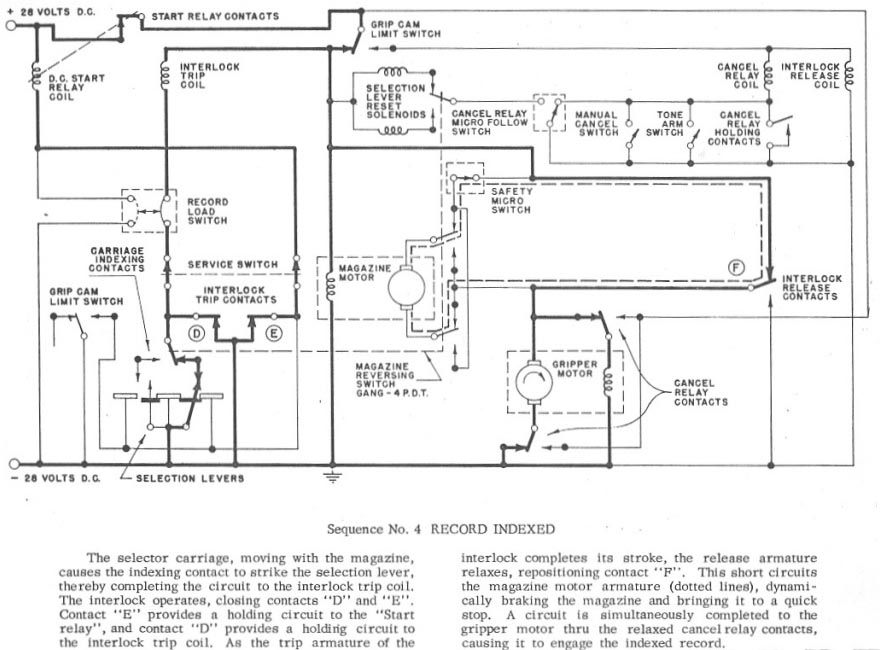
Laut Service Manual wird der Motor kurzgeschlossen, sobald die Wahl gefunden
wurde. Der gestrichelt eingezeichnete Stromkreis der nachfolgenden
Sequenz hat daher höchstwahrscheinlich eine Unterbrechung. |
|
For some time now, the
record magazine does not exactly where it should. At first it
stops slightly after the selected record, but then it stops
several compartments later. At the end it does not switch off at
all, the corresponding pin does not get reset.
Answer:
A precondition for finding the right selection is that the
contacts of the carriage which searches the selections, can work
properly. They should be very clean:
http://www.jukebox-world.de/Forum/Archiv/FAQ-RO/Wahlprobleme-1485.htm#Pins
It is possible that the carraige is poorly adjusted, has play
and runs sluggishly. This results in a delayed stop. The record
magazine could also be poorly adjusted.
However, if the correct stopping becomes worse the longer the
jukebox is in operation, it could be a thermal problem. This
means that the braking effect deteriorates as the temperature
rises. Or differently: Actually the electric brake does not
work at all and only when still in cold condition viscous grease
brakes the motor.
According to the service manual, the motor is short-circuited as
soon as the selection is found. The dashed circuit in the
following sequence therefore most probably has an interruption.
|
|
Vermutlich sind die "Interlock Release Kontakte" nicht ausreichend
sauber. Abhilfe schafft Reinigen.
Wichtig: nicht mit Schmirgel die Kontakte bearbeiten. Verwendet man
Kontaktsprays wie WD40 o.ä., sollte man die Reste davon wieder
entfernen. Andernfalls können sie nämlich an den Kontakten verkohlen und neue
Probleme erzeugen - Kohle ist leitfähig.
Mehr zum Thema Kontakte und Reinigung:
http://www.jukebox-world.de/Forum/Archiv/FAQ-Technik/Kontakte.htm |
|
The “interlock release
contacts” are probably not sufficiently clean. This can be
remedied by cleaning.
Important: Do not treat the contacts with emery. If you
use contact sprays, WD40 or similar, you should remove the
residue. Otherwise they can carbonize on the contacts directly
and cause new problems - carbon is conductive.
More about contacts and cleaning:
http://www.jukebox-world.de/Forum/Archiv/FAQ-Technik/Kontakte.htm |
|